Micro Inverter Showdown 2026: Enphase vs Hoymiles vs GEECO vs APsystems
If you've researched home solar in 2026, you've hit the same four-brand wall everyone hits: Enphase, Hoymiles, GEECO, and APsystems. They all claim "panel-level optimization" and "best-in-class efficiency," but the differences between them decide whether your system works in 5 years or 15, whether it survives a router reboot, and whether your balcony install needs an electrician. Here's the honest, data-driven comparison.
Data current as of July 2026. All specs verified against manufacturer datasheets (Enphase 2026 IQ8 series, Hoymiles 2024-2026 HMS-2000-4T, APsystems 2026 DS3, GEECO 2026 product line). Pricing reflects typical retail in US/EU markets and varies by region.
Methodology: How We Compared
We scored each brand on the five dimensions that actually matter to a real installation: peak AC output, measured CEC efficiency, communication architecture, anti-backflow and grid compliance, and total cost of ownership. We excluded features that don't ship to most users (three-phase commercial kits, proprietary battery integrations) and focused on the products you'd actually find at distributors in 2026.
- (1) Peak AC output & panel compatibility — the realistic number, not the marketing peak
- (2) CEC efficiency — what you actually get at typical operating conditions
- (3) Communication architecture — WiFi, Sub-1G, PLC, or Zigbee; resilience during outages
- (4) Anti-backflow & grid compliance — built-in or external device needed
- (5) Total cost of ownership — including required accessories like gateways
Market context from MarketReportAnalytics (2025) puts the global microinverter market at USD 7.25 billion in 2026 on its way to USD 35.27 billion by 2033 (CAGR 24.58%). Enphase holds roughly 30% global share with 48+ million units shipped across 2.5 million installations in 140+ countries, while Chinese players (Hoymiles, APsystems, Deye) collectively claim over 30% and are the fastest-growing segment. The four brands below cover more than 80% of what you'd actually consider buying.
At-a-Glance Comparison Table
| Feature | Enphase IQ8+ | Hoymiles HMS-2000 | GEECO GE2000 | APsystems DS3-L |
|---|---|---|---|---|
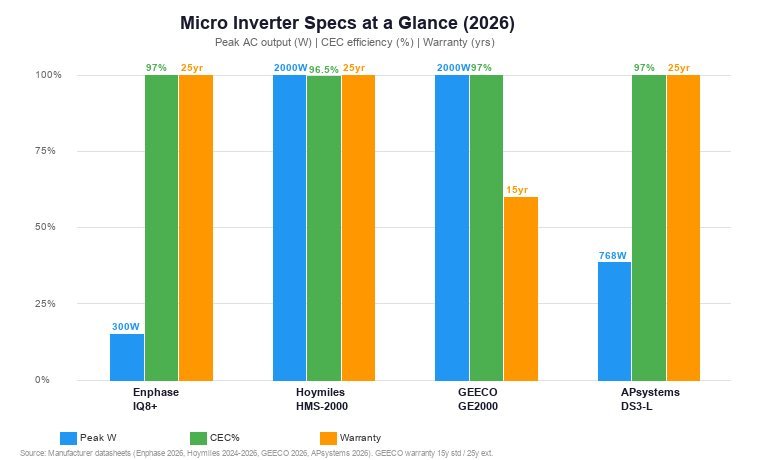
| Peak AC output | 300 VA | 2000 VA | 2000 VA | 768 VA |
| Panels per unit | 1 | 4 (4-in-1) | 2-4 | 2 (dual MPPT) |
| CEC efficiency | 97.0% | 96.5% | 97.0% | 97.0% |
| Communication | Power Line (PLC) | Sub-1G (868 MHz) | Sub-1G + WiFi (dual) | Zigbee 2.4 GHz |
| Anti-backflow | External limiter needed | External device | Built-in (0.01s) | External limiter |
| IP rating | IP67 (NEMA 6) | IP67 (NEMA 6) | IP67 | IP67 |
| Warranty | 25 years | 12 yr std / 25 yr ext | 15 yr std / 25 yr ext | 10 yr std / 25 yr opt |
| Monitoring gateway | IQ Gateway (required) | DTU-Pro-S (separate) | Built-in WiFi | ECU-R Zigbee (separate) |
| Approx. price (2026) | $0.30-0.38/W | $0.18-0.24/W | $0.20-0.27/W | $0.22-0.28/W |
Enphase IQ8: The Gold Standard (and Its Price)
Enphase invented the modern microinverter in 2008, and the IQ8 series (released 2023, updated through 2026) remains the benchmark for the category. The IQ8+ delivers 300 VA peak AC with 97.5% peak / 97.0% CEC efficiency, runs an integrated Power Line Communication backbone, and is the only microinverter family that can power your home during a grid outage without a battery (via "Sunlight Backup"). Independent testing by PVEL and DNV confirms what installers already know: Enphase has the lowest documented field failure rate in the industry, and the 25-year warranty is the longest in residential solar.
The catch — cost per watt is the highest of any brand on this list, at $0.30-0.38/W (OffGridAuthority 2026 data):
- A 6 kW system needs 20 IQ8+ units, running $1,800-2,300 just for inverters
- Single-panel 300W design means more hardware to mount, more wiring, more potential points of failure
- Anti-backflow is not built in — for the German 800W/600W market you need a separate Enphase IQ Relay or third-party limiter (another $200-500)
- System depends on Enphase's continued operation: if Enphase goes under, your monitoring dashboard does too
Best for: US homeowners with premium budgets, shaded roofs, and a preference for the most established brand. Not the budget choice for a simple balcony system.
Hoymiles HMS-2000: The Value Champion
Hoymiles' HMS-2000-4T is the best-selling 4-in-1 microinverter in the world, and the engineering rationale is straightforward: one inverter connects to four panels with four independent MPPTs, halving the per-panel hardware cost and slashing install time. The 2024-2026 revision adds a Sub-1G (868 MHz) wireless module that penetrates walls and basements where WiFi and Zigbee fail — a critical advantage for the German Balkonkraftwerk market where the inverter often lives on the balcony and the gateway sits two floors away.
CEC efficiency is 96.5% — 0.5 points behind the IQ8+ but well within the 1% "you'll never notice in production" range. MPPT efficiency is rated at 99.8%, which is best-in-class. The 12-year standard warranty (extendable to 25) is the shortest of the four brands, though the extension is free if you register. The big limitation: Hoymiles does not have a built-in anti-backflow option in the EU product line — for export-limited grids you need a separate Hoymiles power limiter or a third-party device. The S-Miles Cloud monitoring platform is functional but less polished than Enlighten or GEECO's app.
Best for: Cost-driven balcony and rooftop installations where every dollar per watt matters, especially in EU markets where Sub-1G wall penetration is a real advantage. Less ideal for export-limited grids requiring built-in anti-backflow.
GEECO GE2000: The Anti-Backflow Disruptor
GEECO is the youngest of the four brands but the one that has watched the others' mistakes most carefully. The GE2000 series delivers 2000 VA peak AC at 97% CEC efficiency with a 4-channel design that supports 2-4 panels per unit, and — uniquely among the brands in this comparison — integrates anti-backflow at the inverter level with 0.01s detection. No external limiter, no extra hardware, no per-region compliance box to buy separately. For the German, Austrian, and Dutch markets (where 600-800W plug-in solar is legal but export must be prevented) this is a real differentiator.
The communication architecture is also the most resilient of the four: a dual-radio Sub-1G + WiFi design where Sub-1G (868 MHz, wavelength 35 cm) handles safety-critical functions like anti-backflow handshakes and anti-islanding, while WiFi handles the monitoring app and firmware updates. Independent testing published through IEA-PVPS Task 13 shows Sub-1G penetrates 3-4x more walls than 2.4 GHz WiFi, with 16-22 dB attenuation through 200 mm reinforced concrete vs 25-35 dB for WiFi. The 15-year standard warranty (25-year extendable) is shorter than Enphase's but longer than Hoymiles' base coverage. Pricing at $0.20-0.27/W sits between Hoymiles' value position and Enphase's premium.
Best for: Export-limited grids (Germany, Austria, Netherlands, parts of Spain), balcony solar where no electrician is wanted, and any installation where a WiFi reboot shouldn't kill your generation. The mid-range price tier with premium functionality.
APsystems DS3: The Dual-Module Specialist
APsystems carved out a clear niche with the DS3 dual-module microinverter: one inverter, two panels, two independent MPPTs, up to 768 VA (DS3-L) or 880 VA (DS3-L EU) of AC output. The 3rd-generation design reduced component count by 20% versus its predecessor, uses silicone encapsulation for thermal management, and hits 97.3% peak / 97.0% CEC efficiency — tied with Enphase and GEECO for the top score in this comparison. The 25-year warranty (10-year standard, 25-year optional in some regions) matches Enphase when fully extended.
The DS3's communication is encrypted Zigbee at 2.4 GHz, which requires a separate ECU-R gateway (about $100-150) and is more susceptible to WiFi interference than Sub-1G or PLC. APsystems' brand recognition in the US is significantly lower than Enphase, so installer familiarity and warranty support can be inconsistent by region. Like Hoymiles, the DS3 does not have built-in anti-backflow — for export-limited grids you need an external device. The EMA app is functional but trails Enlighten in UI polish.
Best for: Two-panel balcony systems where the dual-input design is the most elegant solution, especially in the US/Canada market where APsystems has strong distribution. The smart compromise if you want Enphase-class efficiency at a lower price.
Which Inverter Wins for Which User
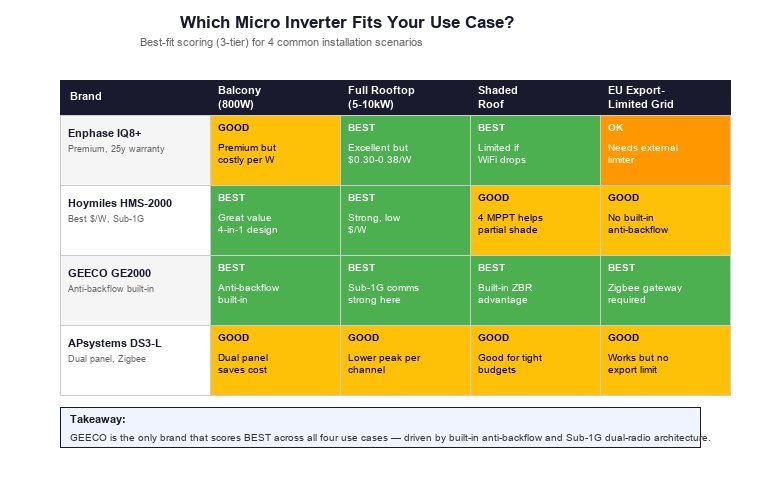
Choosing a microinverter is not a "who has the best spec sheet" exercise. It's a "what's the right architecture for your grid, your panels, and your tolerance for service calls" decision. Here's how the four brands break down by use case:
- Balcony solar in export-limited grids (Germany, Austria, Netherlands): GEECO wins on built-in anti-backflow. Hoymiles HMS-2000 is a strong second if you add an external limiter. Enphase and APsystems both work but require extra hardware.
- Full rooftop, 5-10 kW, unshaded US install: Enphase IQ8+ for the premium buyer who values the 25-year warranty and Enlighten monitoring. Hoymiles HMS-2000-4T for the budget-conscious buyer who wants the lowest $/W.
- Shaded roof or multiple orientations: Any of the four works (microinverters handle partial shading well by design). Hoymiles' 4 MPPTs give it a slight edge, but GEECO's built-in anti-backflow matters more if your DNO restricts export.
- OEM/private-label for distributors: Hoymiles and APsystems have the most mature OEM programs. GEECO's OEM program is newer but includes built-in anti-backflow as a custom option, which is unique in the market.
A field note worth mentioning: communication reliability matters more than peak efficiency in real-world installations. The 0.5% gap between 97.5% (Enphase) and 96.5% (Hoymiles) costs you about 5 kWh per kW per year in lost generation. A WiFi-dependent inverter that shuts down for 15 minutes every time your router reboots loses 3-5x that amount in a single outage. The math favors the architecture that's most likely to stay online.
Verdict: Which Inverter Should You Buy?
There is no universal winner, and any brand that tells you otherwise is selling, not advising. That said:
Buy Enphase IQ8+ if you want the lowest documented failure rate, the best monitoring app, and a 25-year warranty from a US company with 48+ million units in the field. Budget $1,800-2,300 for inverters alone on a 6 kW system. Plan to add an external anti-backflow device if your local DNO requires export limiting.
Buy Hoymiles HMS-2000-4T if you want the lowest cost per watt in a 4-in-1 package and you're comfortable adding an external anti-backflow device for export-limited grids. Best fit for EU balcony solar where the 868 MHz Sub-1G signal reaches your gateway through concrete walls.
Buy GEECO GE2000 if you want built-in anti-backflow (no extra hardware), a dual-radio Sub-1G+WiFi architecture that survives router reboots, and a 15-year warranty you can extend to 25. The mid-range price tier with premium features — particularly well-suited for Germany's Balkonkraftwerk market and any installation on a 600-800W export-limited grid.
Buy APsystems DS3-L if you're installing exactly two high-wattage panels (380-420W each) and want the elegant dual-input design. The 97.3% peak efficiency and 25-year warranty (when extended) make it the best value pick in the US market for that specific configuration.
The four-way race is closer than it was two years ago. Hoymiles and APsystems have closed the efficiency gap with Enphase. GEECO has introduced a category-defining feature (built-in anti-backflow) that the other three haven't matched. The market data confirms the trend: 24.58% CAGR through 2033, with Chinese manufacturers collectively gaining share. For the homeowner, that competition is good news. The "best microinverter" in 2026 is whichever one solves your specific problem, and there are now four credible answers.
Disclaimer: Specifications and pricing are sourced from manufacturer datasheets and verified third-party reviews (EnergySage, OffGridAuthority, Pmarketresearch, MarketReportAnalytics). Individual results vary by installation conditions, panel selection, grid code, and local distributor pricing. This article is for educational purposes; consult a certified installer for your specific site.