Micro Inverter vs String Inverter vs Power Optimizer: 2026 Decision Guide
Choosing an inverter is the most consequential decision in any solar installation. The technology you pick determines your energy yield, monitoring visibility, safety compliance, and total cost over the next 25 years. Yet most buyers default to whatever their installer recommends without understanding the trade-offs. This guide breaks down the three main inverter architectures — string inverter, power optimizer, and micro inverter — so you can make an informed decision based on your actual roof conditions, budget, and long-term plans.
How Each Technology Works: The Quick Definitions
String inverters wire all panels into a series circuit (a "string") and convert the combined DC output to AC at a single wall-mounted unit. Simple, efficient, and cost-effective — but one shaded panel drags down the entire string.
Power optimizers add a small DC-DC module at each panel. Each optimizer performs independent MPPT and sends conditioned DC to a central string inverter for final AC conversion. SolarEdge dominates this category with their HD-Wave inverter plus P-Series optimizers.
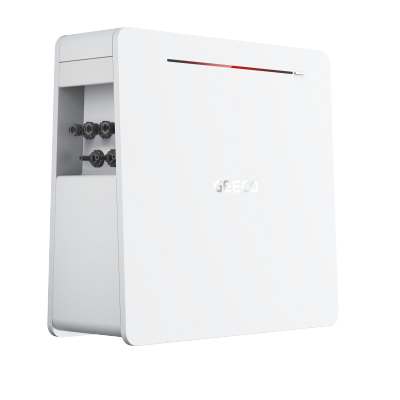
Micro inverters do the full DC-to-AC conversion at every panel. No central inverter, no single point of failure. Each panel operates independently — a shaded chimney corner does not reduce your neighbor's output. Enphase IQ8 leads the market, and GEECO GE2000 adds built-in anti-backflow.
Efficiency: Why Peak Numbers Mislead
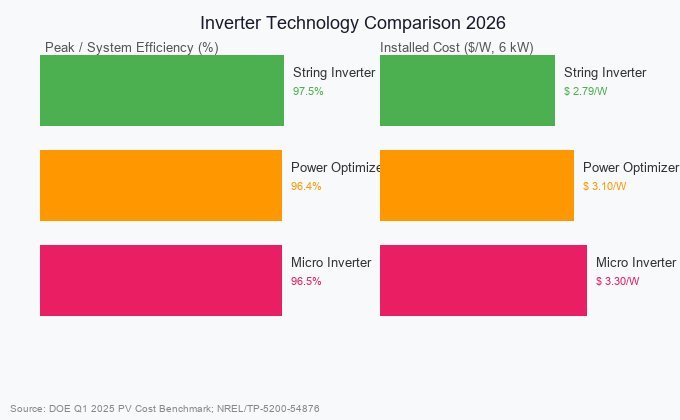
A string inverter may quote 97.5–98% peak efficiency, while micro inverters typically show 95–97%. That gap looks significant on a spec sheet — but it rarely matters in practice. Here is why:
- In shaded conditions, micro inverters produce 3.7–12.3% more total energy than string systems, according to the NREL shading testbed study (Deline et al., NREL/TP-5200-54876). Panel-level MPPT recovers energy that a string loses entirely.
- Power optimizer efficiency stacks: the optimizer DC-DC stage (98.8%) multiplied by the string inverter (97.5%) gives approximately 96.4% combined — slightly below a standalone string inverter at peak, but shading recovery makes the system-level yield comparable to micro inverters.
- Over 25 years, a consistent 7–8% annual shading advantage translates to thousands of dollars in additional energy, far exceeding the efficiency difference on a clean roof.
The takeaway: compare whole-system energy yield, not peak spec-sheet efficiency. A "less efficient" micro inverter on a shaded roof will outperform a "more efficient" string inverter every month.
Cost: Upfront vs Lifetime
The DOE Q1 2025 Solar PV Cost Benchmark puts installed residential systems at approximately $2.79/W for optimizer-based designs versus $3.10/W for micro inverter systems. On a 6 kW project, that gap is roughly $1,860 in hardware and labor.
| Technology | Hardware $/W | 8 kW Premium | Inverter Warranty | Mid-Life Replacement |
|---|---|---|---|---|
| String Inverter | $0.06–0.15 | Baseline | 10–12 years | Yes (once) |
| Power Optimizer | $0.25–0.50 | +$800–1,500 | 25yr optimizer / 12yr inverter | Yes (inverter only) |
| Micro Inverter | $0.35–0.60 | +$1,500–3,000 | 25 years | No |
The lifetime calculation shifts when you include the inevitable string inverter replacement at year 12–15. That swap costs $1,000–2,000 plus labor. Micro inverters with 25-year warranties avoid this entirely, narrowing the long-term cost gap to roughly 5–12% over the full system life.
Shade Performance: The NREL Data That Matters
The US Department of Energy funded a controlled shading test at NREL comparing identical arrays under string, optimizer, and micro inverter architectures. The results are unambiguous:
- Light shading: micro inverters produce 3.7% more than string baseline
- Moderate shading: 7.8% more energy
- Heavy shading: 12.3% more energy
- Both micro inverters and optimizers reduce shading-related annual yield loss from approximately 24% (string) to approximately 9%
On a 6 kW system over 25 years at $0.30/kWh, even a consistent 7.8% gain adds roughly $4,200 in additional energy value — often exceeding the entire upfront premium of a micro inverter system.
Safety and Rapid Shutdown
NEC 2023 Section 690.12 requires rapid shutdown of DC conductors within 30 seconds of activation. This affects each technology differently:
- String inverters need an external rapid shutdown device at each module or string boundary — an added cost and complexity.
- Power optimizers (SolarEdge) include built-in rapid shutdown compliance. Each optimizer ceases DC output when the inverter signal stops.
- Micro inverters inherently comply. AC wiring on the roof means there is no high-voltage DC to shut down — the system de-energizes naturally when the grid disconnects. String systems carry up to 1000V DC; micro inverter systems run 240V AC, which has simpler wiring and lower arc-fault risk.
Battery Integration: DC vs AC Coupling
If you plan to add home battery storage, inverter choice matters early:
- String and optimizer systems support DC-coupled batteries, which charge directly from the DC string — slightly more efficient (1–3% less conversion loss).
- Micro inverter systems require AC-coupled batteries. The battery charges from the AC bus after conversion, adding one conversion step. The efficiency loss is small, but the architecture is different.
- GEECO's approach: the GE2000 micro inverter pairs with GEECO's ultra-thin micro-storage via AC coupling, and the built-in anti-backflow ensures zero-export compliance without an external limiter — a simpler total system than string + separate battery inverter + separate anti-backflow device.
The GEECO Advantage: Anti-Backflow Built In
Most string and optimizer systems require an external export limitation device when local regulations prohibit surplus grid feed-in (increasingly common in Europe and Asia). That device adds cost, wiring complexity, and another potential failure point.
The GEECO GE2000 micro inverter integrates anti-backflow detection at the inverter level with 0.01s response time. This means:
- No external limiter hardware to purchase or install
- No additional commissioning step
- Immediate compliance with zero-export regulations in Germany, Spain, China, and other markets
- One device per panel handles MPPT, DC-AC conversion, rapid shutdown, and anti-backflow — four functions in a single unit
Honest limitation: anti-backflow is a regulatory convenience, not a revenue generator. In markets with favorable feed-in tariffs, exporting surplus earns money. GEECO's dual-mode flexibility lets you switch between zero-export and export as regulations change — but the feature is most valuable where export is restricted or penalized.
Decision Framework: Which Technology for Which Roof?
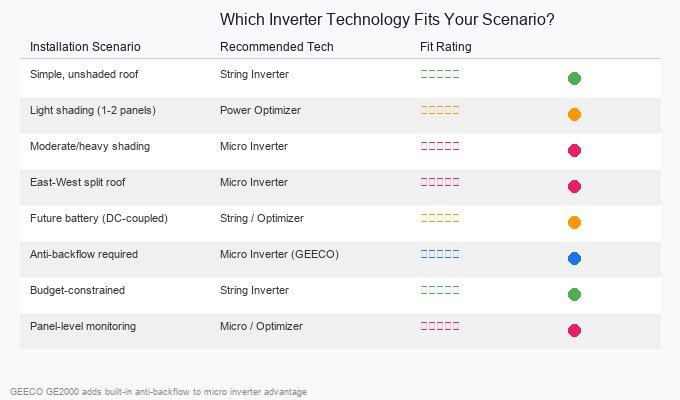
Use this practical decision logic:
- Simple, unshaded south-facing roof: string inverter. Lowest cost, highest peak efficiency, simplest maintenance.
- Partial shading or mixed orientations: power optimizer (SolarEdge) or micro inverter. Optimizers cost less; micro inverters offer no single point of failure and easier expansion.
- Heavy shading, dormers, east-west split, or future expansion: micro inverter. The yield advantage and flexibility outweigh the cost premium.
- Anti-backflow required + any shade: GEECO GE2000 micro inverter. Built-in zero-export eliminates an entire device category from your system.
The Bottom Line
There is no universally "best" inverter technology. The right choice depends on three factors: your roof complexity, your budget, and your regulatory environment. On a clean roof with no shade and no export restrictions, a string inverter delivers the best economics. On anything more complex — shade, multiple orientations, zero-export compliance, or future expansion — micro inverters or optimizers recover their upfront premium through higher yield, lower maintenance risk, and regulatory simplicity.
GEECO's GE2000 occupies a unique position: it is a micro inverter with anti-backflow built in, eliminating the external limiter that string and optimizer systems need in zero-export markets. If your installation faces any shade and any export restriction, that single feature removes an entire category of additional hardware from your bill of materials.