Balcony Solar Systems 101: Everything Apartment Dwellers Need to Know in 2026
Imagine plugging a solar panel into your wall outlet the same way you plug in a toaster — and watching your electricity meter slow down in real time. This is not science fiction. In 2026, balcony solar systems — also known as plug-and-play solar or "Balkonkraftwerke" in Germany — have become one of the fastest-growing segments in residential energy. With the global balcony solar market reaching an estimated USD 1.4 billion in 2026 and projected to grow at an 18.5% CAGR to USD 7.02 billion by 2035 (Business Research Insights, 2026), this technology is reshaping who can access solar energy.
Whether you live in a rented apartment in Berlin, own a condo in California, or manage multi-family housing in Shanghai, balcony solar offers a tangible path to generating your own clean electricity — no rooftop required, no electrician needed in most cases, and no permanent modifications to your home. This guide covers everything you need to know, from components and installation to legal requirements and real-world savings.
What Is a Balcony Solar System?
A balcony solar system is a compact photovoltaic (PV) setup designed specifically for urban residential environments — typically mounted on balcony railings, terraces, or exterior walls. Unlike traditional rooftop solar arrays that require professional installation and permanent structural changes, balcony systems are plug-and-play appliances that connect directly to a standard household wall outlet.
How Balcony Solar Differs from Conventional Solar
The key difference is scale and approach. Traditional residential solar systems range from 3 kW to 10 kW and require professional installation, permits, and utility interconnection agreements. Balcony solar systems, by contrast, typically operate in the 300W to 900W range — enough to offset the "always-on" baseline consumption of a home's refrigerator, WiFi router, standby electronics, and other vampire loads (Solar.com, 2026).
A standard 800W balcony solar kit — the most common configuration in 2026 — can cover approximately 15% to 25% of a typical apartment's monthly electricity consumption. In Germany, where electricity prices exceed €0.30/kWh, that translates to real savings of €180 to €270 per year (VoltPicks, 2026).
Typical System Specifications
| Component | Typical Range | Notes |
|---|---|---|
| Total System Power | 300W – 900Wp | 52% of systems are in the 300–600W range (Business Research Insights, 2026) |
| Panel Count | 1–3 panels | 2 panels is the most common configuration |
| Inverter Output | 600W – 800W | Regulated limit varies by country |
| Panel Efficiency | 20% – 23% | Premium panels using N-Type IBC technology reach 22.7%+ |
| Weather Rating | IP65 – IP68 | IP67 recommended for outdoor year-round exposure |
| System Cost | $600 – $1,500 | Complete kit including panels, inverter, and mounting |
Who Can Install a Balcony Solar Kit?
One of the most common questions is "Can I really install solar if I'm renting?" The short answer is: in most cases, yes. Balcony solar was designed from the ground up for people who do not own their roof — renters, apartment dwellers, and condo owners who cannot modify building exteriors.
Renters and Apartment Dwellers
Germany's landmark "Solarpaket I" law (enacted 2024) explicitly protects tenants' rights to install balcony solar systems. Landlords cannot unreasonably refuse installation requests, and the clamp-based mounting systems leave zero permanent marks on railings or walls. When you move, you simply unclamp the panels and take your personal power plant with you.
In the United States, the legal picture is evolving rapidly. As of April 2026, nearly 30 states have introduced or passed plug-in solar legislation. Utah led the way with its 2025 plug-and-play law exempting systems up to 1.2 kW from utility interconnection requirements. Maine's balcony solar bill was signed into law in April 2026, with Virginia and Colorado close behind (Solar.com, 2026).
Homeowners
If you own your home but lack suitable roof space — or simply want to start small before committing to a full rooftop installation — balcony solar is an ideal entry point. The systems can be installed in under two hours and provide immediate, measurable savings without the complexity of permits and professional installation.
Multi-Family Building Owners
Property managers of apartment buildings are increasingly offering balcony solar kits as an amenity to attract eco-conscious tenants. By partnering with manufacturers through OEM programs — such as GEECO Solar's micro inverter solutions — building owners can deploy standardized, safe systems across dozens of units with minimal maintenance overhead.
Essential Components of a Balcony Solar Setup
A balcony solar system consists of four core components. Understanding each one helps you make an informed purchase decision and avoid cutting corners on quality.
1. Solar Panels
Modern balcony solar panels are typically monocrystalline modules rated between 350W and 450W each. The most efficient models use N-Type IBC (Interdigitated Back Contact) technology, achieving conversion efficiencies of up to 22.7%. Bifacial panels — which can capture reflected light from the back side — offer an additional 5–15% power boost when mounted against light-colored walls or balcony floors.
- Monofacial (standard): Single-sided power generation; most cost-effective for dark balcony backgrounds
- Bifacial: Dual-sided generation; ideal for white or light-colored mounting surfaces
- Flexible/lightweight: Thin-film or semi-flexible panels for weight-restricted balconies; slightly lower efficiency
2. Micro Inverter
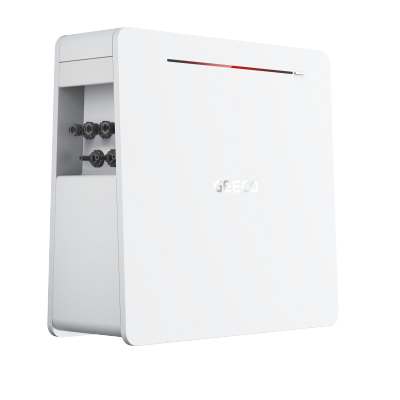
The micro inverter is the brain of the system — it converts the DC electricity generated by the solar panels into AC electricity that your home can use. More importantly, it handles critical safety functions. A quality micro inverter should feature IP67 waterproofing (meaning it can withstand rain and dust year-round), panel-level MPPT (Maximum Power Point Tracking) for optimal efficiency, and built-in safety protections.
The 2026 trend is toward inverters with integrated anti-backflow technology — a feature that prevents excess solar power from flowing back to the grid without the need for external limiting devices. GEECO's latest high-efficiency micro inverters incorporate this functionality at the inverter level, simplifying compliance with utility regulations while reducing total system cost and complexity.
3. Mounting Hardware
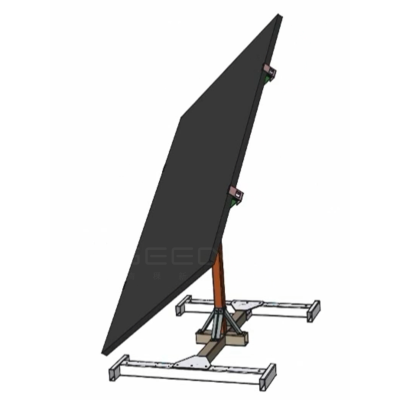
Balcony mounting systems use non-destructive clamp mechanisms designed to attach securely to standard balcony railings, parapets, or walls. Most kits include:
- Adjustable clamps (fits railing diameters from 20mm to 60mm)
- Stainless steel or aluminum brackets (corrosion-resistant, rated for outdoor use)
- Safety tethers or secondary attachment points for high-wind areas
- Tilt-angle adjustment (typically 10°–70°; 30°–40° is optimal for most latitudes)
4. Optional: Micro-Storage Battery
While not required, a micro-storage battery (2–5 kWh) lets you store surplus daytime generation for evening use — when you are actually home using electricity. This dramatically improves the economics by increasing self-consumption from roughly 30% (without storage) to 70% or more. Solutions like the EcoFlow PowerStream integrate directly with portable power stations, while GEECO's ultra-thin micro-storage ecosystem connects seamlessly with its inverter lineup for a unified energy management experience.
The Legal Landscape: Where Is Balcony Solar Allowed?
Regulations vary significantly by region. Understanding the rules where you live is essential before purchasing.
Germany: The Global Leader in Balcony Solar
Germany is the undisputed pioneer. Over 435,000 new balcony solar units were registered with the Bundesnetzagentur in 2024 alone — a 36% year-over-year increase through early 2025. The country's "Solarpaket I" legislation raised the permissible inverter output from 600W to 800W in 2024, simplified registration to a basic online form, and legally protected tenants' right to install. As a result, more than two million German households now have a Balkonkraftwerk (Business Research Insights, 2026).
European Union: A Fragmented but Forward-Looking Picture
The EU Renewable Energy Directive encourages member states to remove barriers to small-scale solar. However, implementation varies:
- Netherlands: "Plug-in solar" is explicitly permitted; no registration required for systems under 600W
- France: Evolving framework; balcony solar allowed with simplified declaration procedures
- Austria: Similar to Germany with strong government promotion initiatives
- Spain and Italy: Emerging markets with different requirements; typically require a certified electrician for connection
- United Kingdom: Still developing specific balcony solar regulations; general building regulations apply
United States: The Rapidly Changing Frontier
The U.S. is experiencing a legislative wave. As of mid-2026, approximately 30 states have introduced or passed balcony/plug-in solar bills. The new UL 3700 safety standard (launched by UL Solutions in early 2026) provides the technical framework for certification, covering automatic power cut-off when unplugged, grid outage protection, overload prevention, and weatherproofing requirements (Solar.com, 2026).
China and Asia-Pacific
China — the world's largest solar panel manufacturer — is seeing growing domestic demand for balcony systems, particularly in dense urban centers like Shanghai and Shenzhen. Japan's compact urban housing stock makes balcony solar especially relevant, while South Korea and India are emerging markets with growing policy support for distributed generation.
Step-by-Step Installation Guide
Installing a balcony solar system is genuinely achievable in a single afternoon — no electrician, no permits, and no permanent modifications. A homeowner in Munich told us, "I mounted two panels on my south-facing balcony railing in under 90 minutes. The hardest part was untangling the cables." Here is the typical process:
Step 1: Choose Your Location and Orientation
South-facing balconies capture the most direct sunlight and produce the highest output. East-facing panels generate more power in the morning; west-facing panels peak in the afternoon. Even north-facing balconies with bifacial panels can generate meaningful power — roughly 50–60% of a south-facing equivalent. Measure your railing length to ensure your panels fit; a standard 2-panel setup requires approximately 2.0–2.5 meters of railing space.
Step 2: Mount the Panels
Attach the clamps to your railing at the specified spacing, secure the panels to the clamps, and set the tilt angle (typically 30° for optimal annual production). Ensure all fasteners are tightened to the manufacturer's torque specifications. For high-wind areas above the 5th floor, consider adding safety tethers.
Step 3: Connect Panels to the Micro Inverter
Plug the panel cables (typically MC4 connectors) into the micro inverter input ports. Most modern inverters support dual MPPT channels — connect each panel to a separate channel for independent optimization, which is critical if one panel may be partially shaded during the day.
Step 4: Plug into Your Wall Outlet
Connect the inverter's AC output cable to a standard wall outlet (Schuko plug in Europe, NEMA 5-15 in North America). This is the moment of truth — the inverter will perform a self-test, synchronize with the grid, and begin feeding power into your home circuit. Systems with built-in anti-backflow — a standard feature on GEECO's micro inverters — will automatically regulate output to match your consumption, preventing excess power from flowing back to the grid.
Step 5: Configure the Monitoring App
Download your inverter manufacturer's app, connect to the system via WiFi or Bluetooth, and complete the initial setup. You will see real-time generation data, cumulative energy production, and estimated CO2 savings. Some advanced platforms — like GEECO's AIoT-powered EMS — also provide consumption forecasting and dynamic scheduling based on time-of-use electricity pricing.
Real-World Performance: How Much Power Can You Expect?
Understanding realistic output is essential for setting expectations and calculating ROI. Data from thousands of installed systems provides a reliable picture.
Seasonal Variation
| Season | Daily Output (800W System) | Monthly Output |
|---|---|---|
| Summer (Jun–Aug) | 3.0 – 4.5 kWh/day | 90 – 135 kWh |
| Spring / Autumn | 2.0 – 3.5 kWh/day | 60 – 105 kWh |
| Winter (Dec–Feb) | 0.5 – 1.5 kWh/day | 15 – 45 kWh |
| Annual Total | — | 600 – 900 kWh |
Data sources: VoltPicks testing (2026), Solar.com analysis, and manufacturer specifications. Actual output varies based on latitude, orientation, shading, and local weather patterns.
What 800W Actually Offsets
An 800W system producing 750 kWh per year covers the annual energy consumption of:
- A modern energy-efficient refrigerator (300–400 kWh/year) — completely covered
- Home networking equipment: router, modem, switches (~100 kWh/year) — completely covered
- Standby electronics and vampire loads (~200 kWh/year) — completely covered
- LED lighting for a typical apartment (~100 kWh/year) — covered
In short, an 800W balcony solar system effectively eliminates the "always-on" portion of most apartment electricity bills — the part you are paying for 24/7 regardless of whether you are home.
Cost, Savings, and ROI Analysis
Balcony solar has one of the fastest payback periods in renewable energy, largely because the upfront costs are low and the systems require zero professional installation.
Upfront Investment
| Item | Cost Range |
|---|---|
| Complete 600W kit | $400 – $700 |
| Complete 800W kit | $600 – $1,100 |
| Optional micro-storage (2 kWh) | $500 – $1,200 |
| Professional installation (optional) | $100 – $300 |
Annual Savings by Region
| Region | Electricity Rate | Annual Savings (750 kWh) | Payback Period |
|---|---|---|---|
| Germany | €0.30–0.40/kWh | €225 – €300 | 2.5 – 4 years |
| EU Average | €0.20–0.30/kWh | €150 – €225 | 3 – 5 years |
| United States | $0.12–0.25/kWh | $90 – $188 | 4 – 8 years |
| China | ¥0.5–0.8/kWh | ¥375 – ¥600 | 3 – 5 years |
ROI Over 25 Years
Consider an €800 balcony solar kit installed in Germany. At €270 annual savings, payback occurs in approximately 3 years. Over the system's 25-year operational lifespan (panels typically carry 25–30 year performance warranties), total savings reach approximately €6,750 — an 8.4x return on the initial investment, even before accounting for rising electricity prices. And unlike a rooftop system, you can take it with you when you move.
Common Mistakes First-Time Balcony Solar Users Make
Learning from others' experience can save you time, money, and frustration. Here are the most frequent pitfalls — and how to avoid them.
1. Buying Panels That Are Too Large for Your Railing
Measure twice, order once. A standard 400–450W panel measures roughly 1.7m × 1.1m, and you typically need space for two. Verify your railing length before purchasing, and confirm that your mounting clamps are compatible with your railing diameter and material (metal, concrete, or wood).
2. Ignoring the Importance of the Micro Inverter
Many first-time buyers focus exclusively on panel wattage while treating the inverter as an afterthought. This is a critical error. A cheap inverter with poor MPPT efficiency can waste 3–5% of your generation every single day — compounding to significant losses over 25 years. The micro inverter also handles all safety functions. Look for at least IP67 waterproofing, 99%+ MPPT efficiency, and built-in anti-backflow capabilities like those found in GEECO's high-efficiency micro inverter series.
3. Expecting to Cover Your Entire Electricity Bill
A balcony solar system is a consumption reducer, not a bill eliminator. An 800W system offsets the always-on baseline — roughly 15–25% of a typical apartment's consumption. If your goal is net-zero electricity, you need a full rooftop installation. Balcony solar is about accessible, incremental savings.
4. Neglecting the Grid Compliance Angle
In many jurisdictions, feeding excess power back to the grid triggers regulatory requirements, bidirectional meter installations, and utility agreements. Systems with integrated anti-backflow technology eliminate this headache entirely — they ensure zero export to the grid, keeping you compliant without any additional hardware or paperwork.
5. Skipping the App Setup
The monitoring app is not just a nice-to-have. It provides real-time visibility into generation, alerts you to issues (like a panel that stopped producing due to a loose connection), and helps you optimize consumption timing. Set it up on day one.
Why Anti-Backflow Technology Is Critical for Safe Balcony Solar
One of the most important — and least discussed — features in a balcony solar system is anti-backflow (zero export) technology. It is the reason many balcony solar systems can legally plug into a standard wall outlet without utility interconnection agreements.
What Anti-Backflow Does
A grid-tied inverter without anti-backflow sends every watt of generated power into your home circuit. If your home is consuming less than the panels are producing, the surplus flows backward through your meter and onto the utility grid. This triggers a cascade of regulatory requirements: bidirectional meters, interconnection studies, utility approval, and export agreements. Anti-backflow prevents this by dynamically regulating inverter output to match your real-time consumption — down to the watt. The moment the inverter detects potential export, it throttles output within 0.01 seconds.
Built-In vs External Anti-Backflow
| Feature | External Limiter | Built-In (GEECO) |
|---|---|---|
| Additional Hardware | CT clamp + limiter device required | Integrated into inverter firmware |
| Response Time | Typically 0.2–1.0 second | Sub-0.01 second |
| Installation Complexity | Requires electrician for CT clamp | True plug-and-play |
| System Cost | +$100–250 for limiter | Included; no added cost |
| Single Point of Failure | Limiter device adds failure risk | Redundant within inverter system |
This is why a growing number of balcony solar manufacturers — including GEECO — have made built-in anti-backflow a standard feature. It simplifies the user experience, reduces total system cost, and eliminates a common single point of failure. For anyone installing in a region with strict export regulations (most of Europe and increasingly the U.S.), it is not just convenient — it is essential.
What's Next for Balcony Solar: Market Trends and Innovations
The balcony solar market is not just growing — it is evolving rapidly. Several trends are converging to make these systems more powerful, more intelligent, and more accessible.
The Appliance-ization of Solar
The most significant paradigm shift is the reclassification of small solar systems as household appliances rather than power plants. This is already happening in Germany (Solarpaket I), Utah (plug-and-play legislation), and several EU member states. When a solar kit is treated legally as an appliance — not unlike a dishwasher or air conditioner — the barriers of permitting, inspection, and utility approval disappear overnight. According to market research, approximately 45% of new balcony solar adopters prefer DIY installation (Business Research Insights, 2026), underscoring the demand for truly plug-and-play products.
AI-Driven Energy Management
The next generation of micro inverters — exemplified by GEECO's AIoT platform — incorporates machine learning for consumption prediction, dynamic scheduling, and real-time optimization. These systems learn your household's usage patterns and automatically decide when to charge a battery, when to throttle output, and when to maximize self-consumption based on time-of-use electricity pricing. This transforms a passive solar panel into an intelligent energy node.
The Micro-Storage Revolution
Compact lithium iron phosphate (LFP) batteries in the 2–5 kWh range are the fastest-growing accessory category for balcony solar. By storing daytime generation for evening use, they increase self-consumption from approximately 30% to over 70%, dramatically improving ROI. Manufacturers are also exploring ultra-thin form factors designed to mount flush against balcony walls — invisible storage that requires zero indoor floor space.
Market Growth Trajectory
With the global market projected to grow from USD 1.4 billion in 2026 to over USD 7 billion by 2035 (CAGR 18.5%), balcony solar is transitioning from a niche German phenomenon to a mainstream global energy solution. Europe currently accounts for roughly 50% of global installations, but North America and Asia-Pacific are the fastest-expanding regions as regulatory frameworks catch up with technology (Business Research Insights, 2026).
If you are considering joining the balcony solar movement, there has never been a better time. The technology is mature, the regulations are evolving favorably, and the economics are compelling. Whether you are a renter looking to shrink your electricity bill, a homeowner testing the solar waters, or a distributor exploring the fastest-growing segment in residential energy, balcony solar in 2026 represents a genuine inflection point in how we think about — and access — clean energy.
Ready to get started? Explore GEECO Solar's complete range of high-efficiency micro inverters with built-in anti-backflow technology, purpose-built for balcony and plug-and-play solar installations. From compact 600W kits to expandable 800W+ systems with AIoT energy management, GEECO has a solution designed for your balcony, your budget, and your energy goals.