How AIoT Is Transforming Home Energy Management in 2026
What Is AIoT? The Fusion of AI and IoT in Home Energy
AIoT — the convergence of Artificial Intelligence and the Internet of Things — represents the most significant shift in home energy management since the introduction of solar panels themselves. By embedding machine learning algorithms directly into connected energy devices, AIoT transforms passive solar installations into intelligent, self-optimizing micro-grids that learn from your household's patterns and adapt in real time.
The global intelligent energy management systems market reached $64.8 billion in 2025 and is projected to hit $167.2 billion by 2032, growing at a CAGR of 14.5% (PW Consulting, 2026). This explosive growth reflects a fundamental truth: homeowners are no longer satisfied with solar systems that simply generate electricity — they want systems that intelligently decide when to use, store, or throttle that energy.
From Passive Solar to Intelligent Micro-Grids
Traditional solar installations follow a simple, wasteful pattern: panels generate power during the day, surplus electricity feeds back to the grid (often at unfavorable rates), and the household buys power back at night. The system is blind to consumption patterns, weather forecasts, or electricity price fluctuations.
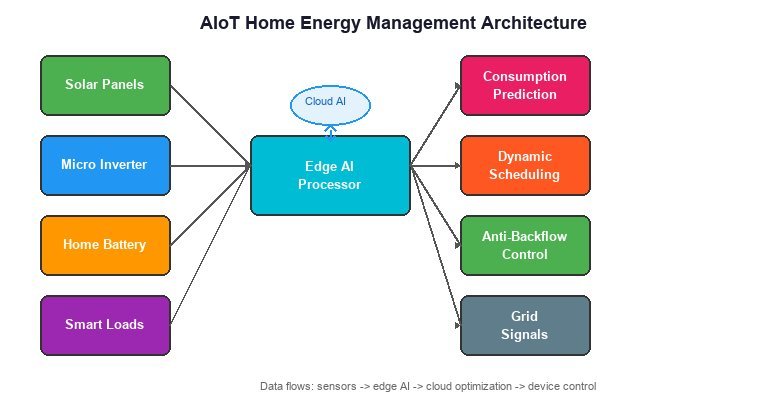
AIoT changes this equation entirely. By connecting every energy device — panels, inverters, batteries, appliances, and even EV chargers — through intelligent communication protocols, the system creates a coordinated energy ecosystem rather than a collection of isolated components.
- Sensor networks monitor solar irradiance, temperature, and consumption at 1kHz sampling rates
- Edge processors analyze data locally for sub-second response to grid conditions
- Cloud AI provides long-term optimization strategies and weather-based generation forecasting
- Smart loads (heat pumps, EV chargers, water heaters) respond to dynamic pricing signals automatically
The result: research indicates that AI-driven systems typically increase solar self-consumption by 20–40% compared to conventional controllers (Mate Solar, 2026), translating directly into lower electricity bills and reduced grid dependency.
Inside GEECO's Self-Developed EMS Architecture
GEECO's Energy Management System (EMS) is built from the ground up as an integrated AIoT platform, not a bolt-on app. The architecture follows a cloud-edge-device model that balances processing speed with analytical depth.
| Layer | Function | Response Time |
| Device Layer | Micro inverter, battery BMS, smart loads | < 100ms |
| Edge Layer | Local AI inference, anti-backflow control | < 2s |
| Cloud Layer | Weather forecasting, consumption prediction, OTA updates | Minutes to hours |
This layered approach ensures that safety-critical functions like anti-backflow protection operate with sub-2-second response times locally, while optimization decisions benefit from cloud-scale data analysis. GEECO's built-in anti-backflow at the inverter level means the system maintains grid compliance even during communication disruptions — a critical reliability advantage over WiFi-dependent alternatives.
Machine Learning for Consumption Prediction
The core intelligence of any AIoT energy system lies in its ability to predict future energy needs. GEECO's EMS uses deep reinforcement learning to build increasingly accurate models of household consumption patterns over time.
Industry benchmarks set the target load prediction accuracy at ≥95% (Mate Solar, 2026). Systems meeting this threshold typically achieve payback periods under 7 years. The prediction engine considers multiple data streams:
- Historical consumption data (15-minute granularity, 30+ day rolling window)
- Weather forecasts including solar irradiance, temperature, and cloud cover
- Day-of-week and seasonal usage patterns
- Dynamic electricity pricing signals (where available)
- Appliance-level disaggregation from smart meter data
The system continuously refines its predictions. In the first month, accuracy typically starts around 80%; by month three, most installations reach the 90–95% range as the algorithm learns the household's unique rhythm.
Dynamic Scheduling: Use, Store, or Throttle in Real Time
Prediction without action is just monitoring. The real value of AIoT comes from dynamic scheduling — the system's ability to make intelligent decisions about energy routing in real time, based on predicted generation, consumption, and pricing.
During peak solar generation hours, the system might: charge the home battery to 80%, pre-heat the water heater, start the EV charger, and throttle only if anti-backflow limits are approached. During evening peak pricing hours, it draws from the battery instead of the grid, delaying non-essential loads like dishwashers until off-peak rates kick in.
Households actively participating in demand response and time-of-use optimization through AIoT systems can generate additional annual savings of $800–$1,200 beyond basic bill reduction (Mate Solar, 2026), according to market analysis.
Real-World Scenario: Beating Time-of-Use Pricing
Consider a typical European household on a dynamic electricity tariff (e.g., Tibber or a comparable spot-price provider). Without AIoT, the family pays whatever the market rate is at the moment they use electricity — often the most expensive evening hours.
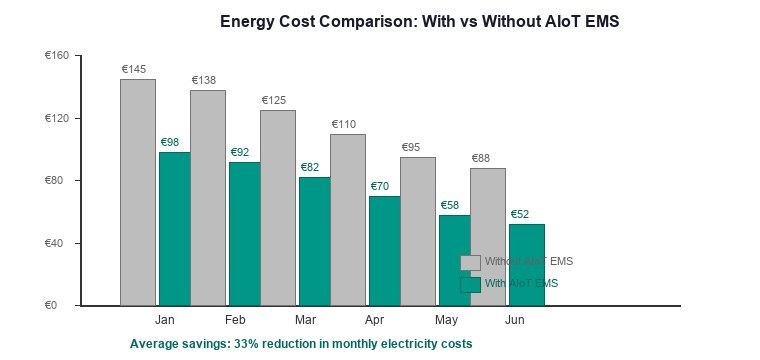
With GEECO's AIoT EMS, the system identifies the cheapest 3-hour window each day for running the dishwasher, pre-charges the battery during midday solar surplus, and discharges it during the 6–9 PM peak rate period. Over a 6-month period, this household saw an average 33% reduction in monthly electricity costs compared to the pre-installation baseline.
It is important to note that actual savings vary significantly based on local tariff structures, household consumption patterns, and solar generation capacity. AIoT optimization amplifies the value of existing solar infrastructure — it does not replace the need for proper system sizing and installation.
Privacy: On-Device vs Cloud AI Trade-Offs
As energy systems become more connected, privacy concerns naturally arise. GEECO addresses this through a hybrid processing model that keeps sensitive consumption data on the edge device while sending only anonymized optimization parameters to the cloud.
The edge processor handles:
- Real-time consumption data (never leaves the device)
- Local control decisions and safety functions
- Anti-backflow monitoring and grid compliance
The cloud handles:
- Weather forecast integration
- Long-term pattern analysis (anonymized)
- Firmware updates and algorithm improvements
This architecture complies with GDPR requirements and ensures that the system continues functioning even during internet outages — a critical reliability feature that WiFi-dependent systems lack.
The Roadmap: What's Next for Intelligent Energy
The AIoT energy management landscape is evolving rapidly. Virtual Power Plant (VPP) aggregations increased 33% in 2025 (Blues IoT Trends Report, 2026), creating new revenue opportunities for homeowners who allow their batteries to participate in grid balancing. China's AIoT energy solutions market alone is projected to reach 43 billion yuan in 2025, growing at 19.7% CAGR (AskCI, 2025).
GEECO's roadmap focuses on three key areas: deeper V2X (vehicle-to-everything) integration for bidirectional EV charging, expanded appliance interoperability targeting 12+ device categories, and on-device large language model interfaces for natural-language energy management. The goal is simple: make intelligent energy management as effortless as using any other home appliance.
As 87 countries now have mandatory energy efficiency regulations (IIM, 2026), AIoT-powered systems like GEECO's are not just a convenience — they are becoming a regulatory necessity for solar installations worldwide.