IP65 vs IP67 vs IP68: What Waterproof Rating Does Your Solar Inverter Really Need?
The IP Code Decoded: What Those Numbers Actually Mean
When you see "IP67" stamped on a solar inverter, those two digits carry precise engineering meaning defined by IEC 60529, the international standard for ingress protection. The first digit (0–6) rates protection against solid objects and dust; the second digit (0–9) rates protection against water. Both matter enormously for outdoor electronics that must survive 25+ years on a rooftop or balcony.
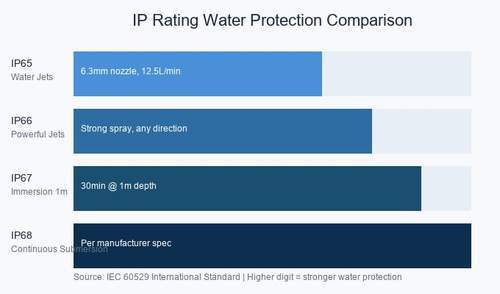
A rating of IP67 means: dust-tight (no particulate ingress at all) and temporary immersion (survives 30 minutes submerged at 1 meter depth). That single digit difference between 5, 7, and 8 tells you whether your inverter can handle a rainstorm, a flood, or living underwater — and misunderstanding it can cost you thousands in replacement and downtime.
IP65: Dust-Tight and Rain-Ready — But Not Flood-Proof
IP65 is the most common outdoor rating for solar inverters. It guarantees complete dust exclusion and protection against water jets from any direction (6.3 mm nozzle, 12.5 L/min flow rate). In practice, an IP65 inverter mounted under an eave or on a wall will survive monsoon rain, wind-driven spray, and daily dust exposure without issue.
However, IP65 does not protect against submersion. If water pools around the unit — on a flat roof after heavy rain, or in a flood-prone ground mount — an IP65 enclosure may let moisture seep through cable glands and connector seals over time. According to field data from 37 inverter models tested in 2025, 23.7% of outdoor inverter failures trace back to water ingress, and the majority occurred in IP65-rated units installed in low-lying or poorly drained positions.
- ✅ Handles: heavy rain, spray, dust storms, typical rooftop conditions
- ❌ Cannot handle: standing water, puddles, temporary flooding, ice-melt pooling
- Best for: wall-mounted or elevated positions with good drainage
IP67: The Submersion Standard That Changes Everything
IP67 adds one critical capability: temporary immersion. The unit can survive 30 minutes under 1 meter of water. This isn't just a theoretical upgrade — it fundamentally changes how you can mount and rely on the inverter in real conditions.
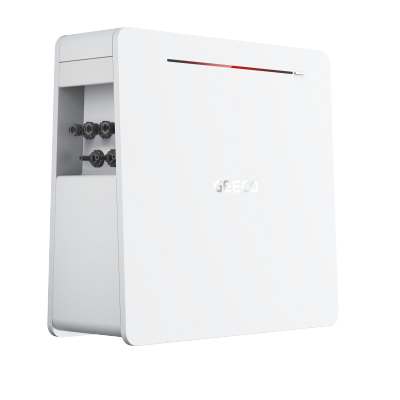
Consider a balcony solar system in Berlin during autumn. Heavy rain can pool on balcony surfaces for hours. An IP65 micro inverter mounted at ground level on the railing could face continuous splash and temporary submersion during extreme weather. An IP67-rated unit like the GEECO GE2000 handles this without concern — the sealed enclosure, conformal-coated PCB, and pressure-equalization valve keep moisture out even when water temporarily rises above the unit.
IEA-PVPS Task 13 field data shows that weatherproof (IP67) inverter systems exhibit 12–18% longer service life compared to standard IP65 enclosures, primarily because reduced moisture ingress lowers thermal fatigue and corrosion on internal components. Over a 25-year solar investment, that longevity difference can mean thousands of dollars in avoided replacement costs.
IP68: Continuous Immersion — Overkill for 99% of Installations
IP68 means the enclosure is rated for continuous submersion beyond 1 meter, with depth and duration defined by the manufacturer. This is the rating you find on submersible pumps, underwater lighting, and pool equipment — equipment designed to live in water permanently.
For solar inverters, IP68 is almost always overkill. The engineering cost is significant: achieving continuous immersion requires double or triple seal barriers, specialized cable glands, and extensive internal conformal coating. These add 20–40% cost premium over IP67 with no practical benefit for any residential or commercial solar installation where the inverter sits above water level.
The only legitimate use case is floating solar (FPV), where junction boxes and connectors may sit at or below water level on reservoir-based arrays. For 99% of homeowners and installers reading this guide, IP68 is money spent on a capability you will never use.
What Happens When Your Inverter Rating Falls Short
Water ingress doesn't announce itself with a dramatic failure. It creeps in slowly — through cable glands that weren't properly sealed, through connector interfaces that degrade under UV, through enclosure seams that lose compression over thermal cycling. The result is a cascade of problems:
| Failure Mode | Time to Appear | Repair Cost | Root Cause |
| Intermittent shutdowns | 6–18 months | $150–400 (labor) | Condensation on PCB traces |
| Corrosion of DC connectors | 2–4 years | $80–200 (replacement) | Moisture through cable gland |
| Complete inverter failure | 3–7 years | $300–800 (full unit) | Seal degradation + flooding |
| MPPT efficiency drop | 1–3 years | Lost revenue, ~$50/yr | Humidity affecting MOSFETs |
A 2025 industry recall involved 3,000 IP66-rated inverters pulled from the market after their rubber sealing rings — rated only to −10°C to 60°C — cracked under UV and thermal cycling, degrading their waterproofing to IP54 within three years. This illustrates that the rating on the label is only as reliable as the materials behind it.
Why GEECO Engineers Chose IP67 for the GE2000
GEECO's GE2000 micro inverter carries an IP67 rating — not because it was the cheapest option, but because the engineering team identified it as the optimal balance of real-world protection and cost efficiency. Here's the rationale:
- Target environment: Balcony and small rooftop installations across Europe, where heavy rain and temporary water pooling are common. IP65 was deemed insufficient for ground-level railing mounts where water accumulates.
- Seal architecture: Triple-layer silicone gaskets with −40°C to 85°C operating range, maintaining ≥30% compression rate throughout thermal cycling. V-type drainage channels at DC/AC ports prevent capillary water ingress.
- Internal protection: Conformal coating on all PCB surfaces and a pressure-equalization valve that prevents condensation buildup inside the sealed chamber — an engineering detail most IP65 inverters skip.
- Cost discipline: IP67 adds approximately 10–15% manufacturing cost over IP65 but eliminates the most common failure category (water ingress). Over a 25-year lifecycle, the IP66+ design reduces failure rates by 41% per Heyun laboratory data, making the premium a net savings.
- IP68 was rejected: The 20–40% cost increase for continuous immersion capability serves no residential or balcony application. Every dollar saved by choosing IP67 over IP68 goes into better MPPT efficiency and monitoring features that deliver real value to the homeowner.
Honest limitation: IP67 does not protect against corrosive salt spray or prolonged chemical exposure. For installations within 5 km of coastline, GEECO recommends IP67 with additional anti-corrosion coating, and elevated mounting at minimum 500 mm from surfaces where salt deposits accumulate.
Choosing Your Rating by Climate: A Practical Guide
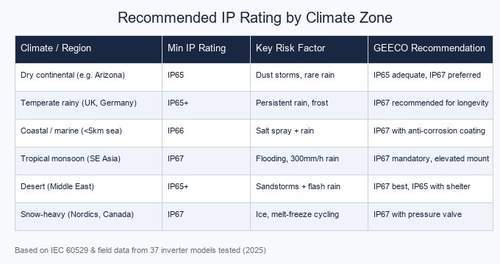
Climate doesn't just determine which IP rating you need — it determines how you should mount and maintain the unit. Here are the practical rules:
- Temperate rainy regions (UK, Germany, Netherlands): IP67 is the smart minimum. Even if your inverter sits under an eave, the freeze-thaw cycling and persistent moisture degrade IP65 seals faster. Mount ≥300 mm from any surface.
- Coastal regions (within 5 km of sea): IP67 with anti-corrosion treatment. Salt spray accelerates seal degradation on any rating. Choose aluminum die-cast housings over plastic.
- Tropical monsoon (Southeast Asia, India): IP67 mandatory. Rainfall rates exceeding 300 mm/hour create temporary flooding on any flat surface. Always mount ≥500 mm above ground with drip-loop cable routing.
- Desert regions (Middle East, Arizona): IP65 may suffice if mounted under shelter, but IP67 is preferred because sandstorms bring fine dust that penetrates lesser seals, and flash floods can submerge ground-level units unexpectedly.
- Snow-heavy climates (Nordics, Canada): IP67 with pressure-equalization valve. Ice-melt-freeze cycling creates internal condensation that destroys unprotected PCBs over years.
Bottom line: If your inverter will ever sit in a position where water can pool around it — even temporarily — IP67 is the right choice. The modest cost premium buys you insurance against the single most common outdoor failure mode. IP68 is for underwater applications, not for rooftops. Choose IP65 only when the unit is guaranteed to stay above any possible water level and is in a mild, dry climate.
For more technical guidance on solar inverter selection, visit GEECO Solar — where IP67 protection comes standard on every micro inverter we build.