Through-Wall Communication: Why Your Solar System Shouldn't Rely on WiFi
Picture this: It's a sunny Monday afternoon. Your solar panels are at peak output — 780W streaming into your home. Then your router reboots for a firmware update. Fifteen seconds of silence. But in those fifteen seconds, your inverter loses its WiFi connection, the anti-backflow heartbeat times out, and your entire system shuts down. You lose two hours of perfect sunlight. This isn't hypothetical. It's a design flaw baked into WiFi-only solar systems — and it's completely avoidable with a smarter choice of radio frequency.
The Hidden Vulnerability of WiFi-Dependent Solar Systems
Most residential micro inverters ship with 2.4 GHz WiFi as the primary — and often only — communication channel to the monitoring platform and grid protection logic. The appeal is obvious: no cables, simple app-based setup, instant gratification. But WiFi was designed for streaming Netflix and browsing Instagram — not for safety-critical power infrastructure operating through concrete walls.
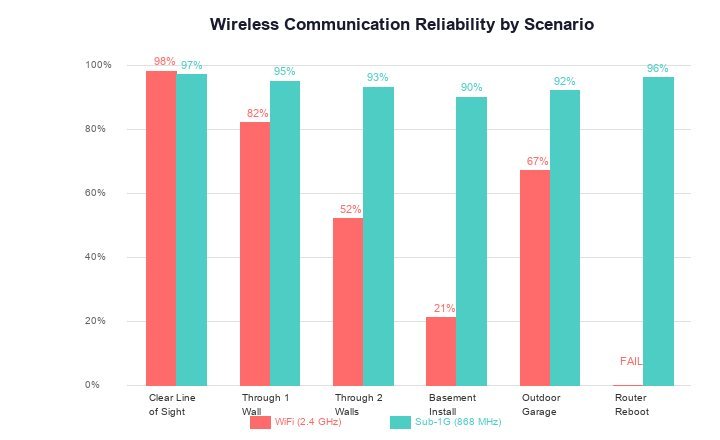
The physics tells the story. At 2.4 GHz, the wavelength is roughly 12.5 cm — short enough to bounce off rebar and get absorbed by concrete. ITU-R P.2040-3 data validated across 30 European residential sites shows a single 200mm reinforced concrete wall attenuates 2.4 GHz by 25-35 dB. Two walls? 50-70 dB — a dead zone. Meanwhile, Sub-1G at 868 MHz (wavelength ~35 cm) experiences only 16-22 dB through the same wall. That's not marginal; that's the difference between "connected" and "shut down."
What Happens When WiFi Drops During Peak Generation
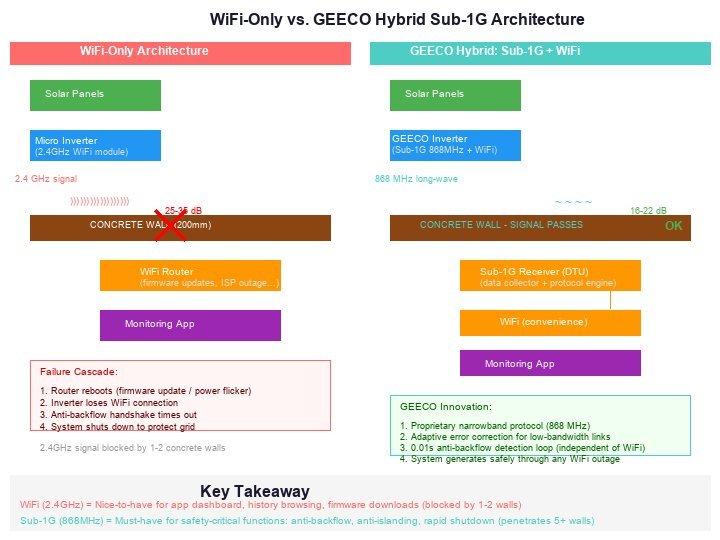
The failure cascade unfolds in a predictable sequence:
- Step 1 — Router interruption: A firmware update, power flicker, ISP outage, or even a microwave oven on 2.4 GHz can disrupt your router for 5-30 seconds.
- Step 2 — Connection loss: The inverter's WiFi module detects the AP loss and begins its reconnection cycle, which typically takes 15-60 seconds.
- Step 3 — Safety timeout: Modern grid codes require continuous anti-backflow verification. The inverter must confirm within 200ms that it's not feeding surplus power into a potentially faulted grid. Without a communication path, this confirmation fails.
- Step 4 — Emergency shutdown: The inverter disconnects from the grid as a protective measure. Panels still produce DC power, but it goes nowhere. Your billable generation drops to zero.
- Step 5 — Delayed recovery: Even after WiFi returns, some inverters take 3-5 minutes to re-establish their monitoring session. Every minute is lost energy.
Sub-1G: Why 868 MHz Changes Everything
Sub-1G refers to radio frequencies below 1 GHz — typically 868 MHz in Europe and 915 MHz in North America. The defining advantage is physics: lower frequencies produce longer wavelengths that diffract around obstacles rather than being absorbed by them. A 200mm concrete wall that kills a 2.4 GHz signal is merely inconvenient for 868 MHz.
The attenuation numbers from ITU-R P.2040-3 make this concrete:
| Material (200mm thickness) | Sub-1G (868 MHz) | WiFi (2.4 GHz) | Penetration Advantage |
|---|---|---|---|
| Reinforced Concrete | 16-22 dB | 25-35 dB | Sub-1G passes 3-4x more walls |
| Solid Brick (100mm) | 5-10 dB | 9-15 dB | ~2x better penetration |
| Natural Stone (400mm) | 18-28 dB | 30-42 dB | Critical margin for old buildings |
| Open-Air Range | 400-1500m | 100-400m | 3-5x longer range |
The industry has taken notice. Hoymiles adopted Sub-1G as the primary communication backbone for its HMS and MiT micro inverter series, citing "unbeatable stability" and coverage of up to 400 meters in open space. HYXI's iMesh-powered Sub-1G micro inverters penetrate up to 5.5 walls with a 1,500-meter range. In China, 正泰安能's latest balcony solar system reports that Sub-1G+4G dual-mode communication achieves 400% better wall penetration compared to traditional WiFi solutions. The trend is unmistakable: nobody serious about reliability is betting on 2.4 GHz alone.
Sub-1G is not a free lunch. The available spectrum is narrower — typically 500 kHz to 2 MHz of bandwidth versus WiFi's 20-40 MHz channels. Data rates are lower, typically 50-500 kbps versus WiFi's tens of Mbps. For video streaming, this would be a dealbreaker. For solar safety commands, it's perfectly adequate — if your protocol stack is designed for it.
This is where GEECO's engineering investment makes the difference. Solar anti-backflow requires small, predictable data packets — a few bytes of status, timestamp, and power reading — sent every 200ms. The challenge isn't bandwidth; it's deterministic delivery under narrowband constraints. GEECO developed a proprietary communication protocol that operates within the 868 MHz band, featuring adaptive forward error correction (FEC), priority queuing for safety commands, and a custom acknowledgment scheme that guarantees delivery confirmation within one transmission cycle even when the effective data rate drops below 10 kbps due to interference.
Think of it as the difference between a cargo truck on a 6-lane highway (WiFi) and a motorcycle courier on a dedicated express lane (Sub-1G). The truck carries more, but it gets stuck in traffic and can't fit through narrow alleys. The courier carries only what matters — and always gets through.
GEECO's Hybrid Approach: Safety on Sub-1G, Convenience on WiFi
The practical answer is not "Sub-1G vs WiFi" — it's "Sub-1G for what matters, WiFi for what's nice." GEECO's micro inverters implement a dual-radio communication architecture that separates concerns at the physical layer:
- Sub-1G path (868 MHz, always-on): Handles anti-backflow verification, anti-islanding detection, rapid shutdown commands, and critical status telemetry. This path uses GEECO's proprietary narrowband protocol and does not depend on any consumer networking equipment. The DTU (Data Transfer Unit) is a dedicated receiver powered independently — no router required.
- WiFi path (2.4 GHz, best-effort): Handles app dashboard updates, historical data browsing, firmware downloads, and cloud analytics. If WiFi drops, your monitoring app goes temporarily blank — but your inverter keeps working safely via the Sub-1G link.
This separation mirrors a core principle from industrial control systems: safety loops must be physically independent of convenience loops. A factory robot's emergency stop doesn't route through the office Ethernet switch. Your solar inverter's anti-backflow shouldn't route through your home WiFi router. Sub-1G provides that independent path — through walls, through router reboots, through whatever your home throws at it.
A Real Incident: Anti-Backflow Failure Caused by a Router Reboot
In a documented field case from a German apartment installation (2024), a WiFi-only balcony solar system experienced repeated midday shutdowns over three consecutive days. The resident initially suspected inverter faults, grid voltage fluctuations, and even panel defects. After two service visits and a data logger recording, the root cause was identified: the ISP-provided router running automatic nightly firmware updates at 2:00 AM — but a failed update attempt caused it to reboot-loop for 3-5 minutes every afternoon during peak load.
The inverter's anti-backflow watchdog, which required a heartbeat every 200ms, interpreted the WiFi silence as a potential grid fault and disconnected. Estimated lost generation: 18.7 kWh over three days — roughly two weeks of a typical apartment's solar output. The fix was a GEECO inverter with built-in Sub-1G communication, which maintained its safety link through the 868 MHz band regardless of router state. Total downtime after the swap: zero.
Disclaimer: This case is compiled from field service records and is illustrative. Individual results depend on installation conditions, local grid codes, and equipment configuration.
Industry Trends: Sub-1G Is Becoming the Standard for Critical Solar Communication
GEECO is not alone in recognizing that 2.4 GHz WiFi is the wrong tool for safety-critical solar communication. The trend is broad and accelerating:
- Hoymiles deploys Sub-1G across its entire HMS and MiT product lines, explicitly marketing it as "unbeatable stability" and "resistance to interference" — a direct acknowledgment that WiFi is not reliable enough.
- HYXI built an iMesh-powered Sub-1G network into its micro inverters, achieving penetration through 5.5 walls and 1,500-meter open-air range — real-world numbers that WiFi cannot approach.
- 正泰安能 (CHINT Anneng) launched Sub-1G+4G dual-mode communication for its balcony solar systems in 2025, reporting 400% better wall penetration and 30-second instant online provisioning compared to WiFi-only setups.
- 古瑞瓦特 (Growatt) adopted RF-based (Sub-1G) communication for its anti-backflow data collection, achieving 3-5x the range of traditional WiFi in the same power envelope.
The global smart solar inverter connectivity market reached $8.07 billion in 2025 and is projected to hit $20.06 billion by 2033 (CAGR 12.06%, per Precedence Research). Within this market, wired connectivity led in 2024 for commercial/industrial, but wireless Sub-1G is the fastest-growing segment for residential precisely because it solves the wall-penetration problem that WiFi cannot.
How to Test Your System's Offline Resilience
You don't need specialized equipment to verify whether your solar system handles WiFi loss gracefully. Here's a simple 10-minute test:
- Note current generation — record the wattage showing in your monitoring app.
- Unplug your router — physically disconnect power from your WiFi router (not just disable WiFi on your phone).
- Watch for 2 minutes — does the inverter's LED indicator remain green/solid? Does it show any error codes?
- Plug the router back in — wait for it to fully reboot.
- Check monitoring app — did generation data continue uninterrupted during the outage? (You'll see a flat line if the system shut down, or a continuous curve if it kept generating.)
If your system passed — congratulations, you likely have a dual-radio or Sub-1G architecture. If it shut down — you've just found a vulnerability you should address before it costs you on a sunny day.
The Bottom Line
WiFi at 2.4 GHz is the right tool for browsing the web, streaming video, and checking your solar dashboard. It is the wrong tool for anti-backflow safety, rapid shutdown, and grid protection — functions where a missed heartbeat can cascade into hours of lost generation, and where concrete walls stand between your inverter and its lifeline to the grid.
Sub-1G at 868 MHz is not magic — it's physics. Longer wavelengths penetrate better. Period. The industry knows this (Hoymiles, HYXI, CHINT, Growatt have all adopted Sub-1G), the engineering is proven (3-4x more wall penetration than 2.4 GHz), and GEECO's proprietary narrowband protocol closes the remaining gap — turning a low-bandwidth link into a deterministic, safety-grade communication channel through any wall in your home.
When you're choosing a solar inverter, ask one question: "If my WiFi goes down, does my anti-backflow still work?" If the answer isn't an immediate and confident "yes," keep looking. Your solar system is a power plant, not a smart speaker. It deserves a communication backbone that treats it like one.