What Is a Micro Inverter? The Complete 2026 Guide to Panel-Level Solar Power
If you have ever wondered how a solar panel turns sunlight into usable electricity for your home, the answer is the micro inverter. This small device, mounted beneath or behind each solar panel, is one of the most important innovations in modern residential solar. In this complete 2026 guide, we will explain what a micro inverter is, how it works, and why it has become the preferred choice for homeowners and installers who want maximum energy yield, safety, and system intelligence.
1. What Is a Micro Inverter? A Simple Definition
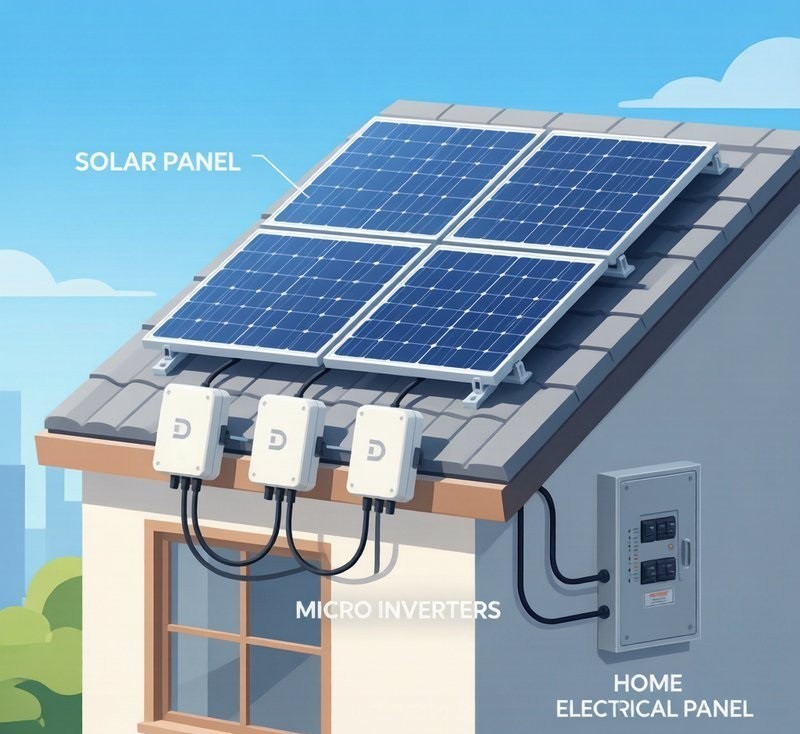
A micro inverter is a compact electronic device that converts the direct current (DC) electricity produced by a single solar panel into alternating current (AC) electricity that your home appliances can use. Unlike a traditional string inverter, which converts power from an entire array of panels at a central location, a micro inverter performs this conversion right at the panel level.
This panel-level approach is the defining characteristic of micro inverter technology. Because each panel operates independently, the performance of one panel does not drag down the rest of the array. This is especially valuable on roofs with partial shading, multiple orientations, or mixed panel types.
According to The Business Research Company, the global micro inverter market is expected to grow from $4.11 billion in 2025 to $4.9 billion in 2026, representing a compound annual growth rate (CAGR) of 19.1%. By 2030, the market is projected to reach $9.63 billion, driven largely by residential rooftop installations and the shift toward module-level power electronics (MLPE).
2. How Does a Micro Inverter Work? The Physics Made Simple
To understand micro inverters, it helps to remember two basic facts about electricity. Solar panels generate direct current (DC), which flows in one direction. The appliances in your home run on alternating current (AC), which changes direction many times per second. An inverter is the bridge between these two forms of electricity.
Here is what happens inside a micro inverter when sunlight hits your solar panel:
- DC input: The panel sends low-voltage DC power into the micro inverter.
- MPPT tracking: The inverter continuously finds the panel's maximum power point, the exact voltage and current combination that produces the most energy.
- DC-to-AC conversion: High-frequency switching circuits convert DC into AC using advanced semiconductor technology.
- Grid synchronization: The inverter matches the frequency and phase of the local electrical grid before feeding power into your home.
- Monitoring: Performance data is transmitted wirelessly to a cloud-based monitoring platform.
Because all of this happens at the individual panel level, the system can extract the maximum possible energy from each module, even when neighboring panels are underperforming.
3. Micro Inverter vs String Inverter vs Power Optimizer
Choosing the right inverter technology is one of the most important decisions in a solar installation. The three main options are string inverters, power optimizers, and micro inverters. Each has its own strengths and ideal use cases.
| Feature | String Inverter | Power Optimizer | Micro Inverter |
|---|---|---|---|
| Cost per kW | $500–$1,000 | $800–$1,200 | $1,000–$1,500 |
| Panel-level optimization | No | Yes (DC only) | Yes (full DC-AC) |
| Shade tolerance | Poor | Good | Excellent |
| Monitoring granularity | String level | Panel level | Panel level |
| Single point of failure | Yes | Yes (central inverter) | No |
| Typical warranty | 5–12 years | 15–25 years | 15–25 years |
| Best for | Simple, unshaded roofs | Moderate shading | Complex roofs, high reliability |
As EnergySage notes, micro inverters and optimized string inverters are typically more expensive than string inverters, but they perform better on complex roofs. For homeowners who want panel-level monitoring, easier future expansion, and the highest reliability, micro inverters are often the best long-term investment.
4. Why Panel-Level MPPT Matters in Real-World Conditions
One of the most important technical advantages of micro inverters is panel-level maximum power point tracking (MPPT). In a string inverter system, the entire string of panels operates at the same voltage. If one panel is shaded, dirty, or malfunctioning, it can reduce the output of every other panel in that string. This is often called the "Christmas light effect."
With micro inverters, each panel has its own MPPT controller. This means:
- Shade on one panel only affects that panel. The rest of the array continues to produce at full capacity.
- Different panel orientations can be mixed. You can install east-facing and west-facing panels on the same roof without compatibility issues.
- System expansion is simpler. You can add panels one at a time without redesigning the entire inverter architecture.
- Real-world energy yields are higher. Independent studies show that micro inverter systems can produce 5% to 25% more energy than string inverter systems under partial shading conditions.
For balcony solar systems and urban installations where partial shading is common, this advantage alone can justify the higher upfront cost of micro inverters.
5. Inside a Micro Inverter: Key Components Explained
Modern micro inverters are remarkably compact, but they contain several sophisticated components working together. Understanding these parts helps explain why quality matters.
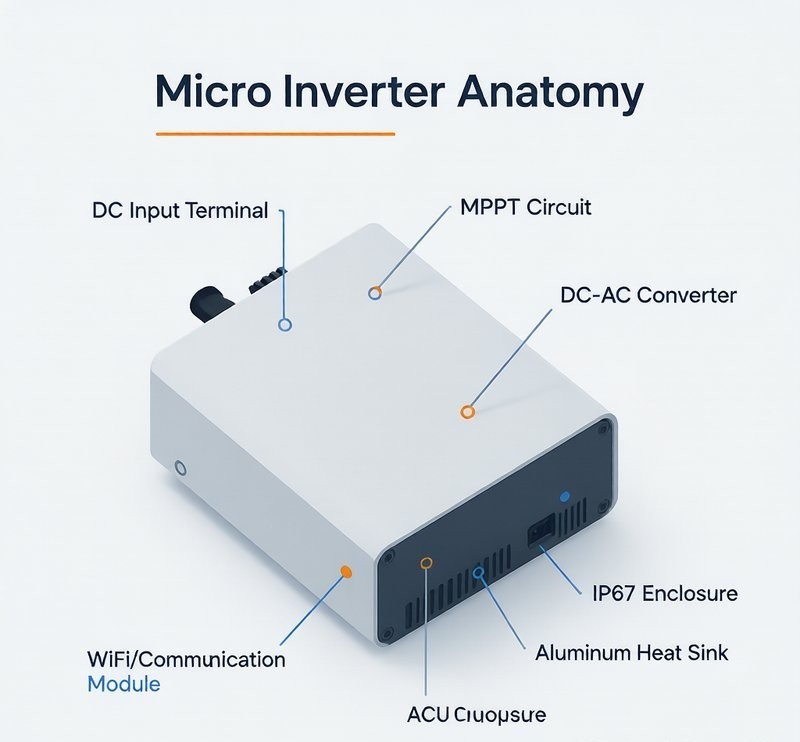
- DC input terminal: Receives low-voltage DC from the solar panel, typically 16–60 V depending on the model.
- MPPT circuit: Continuously adjusts voltage and current to extract maximum power from the panel under changing light and temperature conditions.
- DC-AC converter: Uses high-frequency switching to convert DC into grid-compliant AC power. Peak conversion efficiency typically reaches 96% to 97.5%.
- AC output terminal: Sends AC power directly into the home electrical panel or microinverter bus cable.
- Communication module: Transmits performance data via WiFi, Zigbee, or power-line communication to a monitoring gateway.
- Heat sink: Dissipates heat to maintain performance and longevity. Premium designs use aluminum alloy casings rated up to 60°C ambient temperature.
- IP67 enclosure: Protects internal electronics from dust and water, enabling outdoor rooftop installation without additional housing.
Leading 2025 models, such as those launched at Intersolar Europe 2024, feature plug-and-play installation, ultra-wide MPPT voltage ranges, and integrated monitoring. These improvements reduce installation time while improving reliability in harsh environments.
6. The Evolution of Micro Inverters: From Basic Conversion to Smart Energy Hubs
Micro inverters have come a long way since their introduction. Early generations focused primarily on DC-to-AC conversion. Today's models are intelligent energy devices that connect to smart home systems, support energy storage, and enable advanced grid services.
Key trends shaping the industry in 2025 and 2026 include:
- Hybrid micro inverters with storage and EV charging: Some new models integrate battery storage and EV-charging support into a single panel-level device, improving self-consumption and system flexibility.
- AI-based energy optimization: Machine learning algorithms analyze weather patterns, consumption habits, and grid pricing to optimize energy production and storage dispatch.
- Smart grid connectivity: Modern micro inverters can participate in virtual power plants (VPPs) and demand-response programs, providing grid stability services.
- Integrated anti-backflow control: For balcony solar and zero-export installations, some micro inverters include millisecond-level export limitation to comply with local grid regulations.
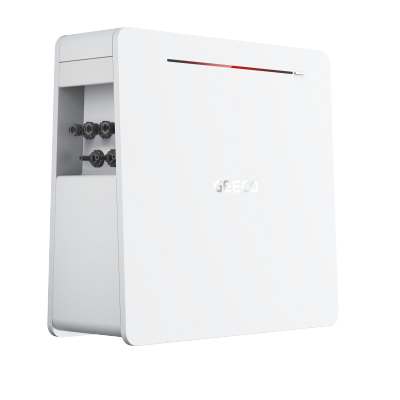
GEECO's micro inverter portfolio, including the GEECO GT3 series, reflects these trends with panel-level optimization, real-time monitoring, and safety features designed for residential and balcony solar applications.
7. Market Data and Regional Adoption Trends
The micro inverter market is growing rapidly across all major regions. According to 2026 market research, North America remains the largest regional market, while Asia-Pacific is the fastest-growing region. This growth is driven by several factors:
- Rising residential solar installations: Homeowners are increasingly choosing micro inverters for their safety, monitoring, and performance advantages.
- Stricter safety regulations: Many jurisdictions now require module-level shutdown or rapid shutdown capabilities, which micro inverters provide natively.
- Balcony solar boom: In Europe, especially Germany with its 600W/800W balcony solar regulations, plug-and-play micro inverter systems are becoming mainstream.
- Grid modernization: Utilities are looking for distributed energy resources that can provide grid services, making smart micro inverters more valuable.
The International Energy Agency reports that solar PV generation increased by 270 terawatt-hours (26%) in 2022, reaching nearly 1,300 terawatt-hours total. Solar PV capacity is expected to surpass coal by 2027, creating sustained demand for high-performance inverters at every scale.
8. How to Choose the Right Micro Inverter for Your System
Selecting a micro inverter involves matching device specifications to your panels, climate, and local grid requirements. Here are the most important factors to consider:
- Power rating: Ensure the micro inverter's continuous AC output matches or slightly exceeds the panel's peak power. Common ratings range from 300W to 800W per unit.
- Efficiency: Look for peak efficiency above 96% and CEC weighted efficiency above 95% for real-world performance.
- Input voltage range: A wider MPPT voltage range (for example, 16–60 V) provides better performance in low-light and high-temperature conditions.
- Protection rating: IP67 or NEMA 6 enclosures are recommended for outdoor rooftop installation.
- Warranty: Premium micro inverters offer 15 to 25 years of warranty coverage, reflecting their long expected lifetime.
- Monitoring platform: Check whether the manufacturer provides a user-friendly app or web portal for real-time system monitoring.
- Certifications: Verify compliance with local standards such as IEEE 1547, UL 1741, IEC 62109, and VDE-AR-N 4105 where applicable.
For most homeowners, a micro inverter system offers the best combination of performance, safety, and peace of mind, especially when the roof has shading, multiple orientations, or plans for future expansion.
9. Micro Inverter Glossary: Key Terms to Know
- DC (Direct Current): Electricity that flows in one direction, produced by solar panels.
- AC (Alternating Current): Electricity that periodically reverses direction, used by household appliances and the grid.
- MPPT (Maximum Power Point Tracking): A technique that adjusts electrical operating conditions to maximize energy output.
- MLPE (Module-Level Power Electronics): Power electronics, such as micro inverters or power optimizers, installed at the individual panel level.
- CEC Efficiency: A weighted efficiency metric from the California Energy Commission that reflects real-world operating conditions.
- IP67 Rating: An enclosure rating indicating complete dust protection and resistance to temporary water immersion.
- Rapid Shutdown: A safety feature that rapidly de-energizes DC conductors in an emergency.
- Anti-Backflow: A control feature that prevents surplus solar power from feeding back into the utility grid.
10. Conclusion: Is a Micro Inverter Right for You?
Micro inverters represent one of the most important advances in residential solar technology. By converting DC to AC at the panel level, they eliminate the "weakest link" problem of string inverters, improve safety with low rooftop DC voltages, and provide detailed monitoring that helps homeowners maximize their investment.
The market data supports this momentum: with a projected CAGR of 19.1% and market size approaching $4.9 billion in 2026, micro inverters are not a niche product—they are becoming the default choice for high-performance residential and balcony solar systems.
If you are planning a solar installation, choosing the right inverter is just as important as choosing the right panels. Explore GEECO's micro inverter solutions to see how panel-level optimization, smart monitoring, and built-in safety features can help you get more energy from every ray of sunlight. Visit GEECO's micro inverter product page to learn more or contact our team for a personalized recommendation.