Zero Export / Anti-Backflow Solar: The Definitive Guide
Zero export solar—also called anti-backflow solar—is no longer a niche configuration for remote microgrids. In 2026, it has become the default connection rule for millions of residential and commercial installations across Germany, the UK, Australia, parts of Southeast Asia, and increasingly North America. Whether you are an apartment dweller with a 600 W balcony system or a facility manager commissioning a 250 kW rooftop array, understanding how zero export works, when it is required, and how to choose the right hardware can mean the difference between a compliant installation and a costly grid-penalty bill.
What Is Zero Export Solar and Why Does It Matter?
Defining the Basic Concept
Zero export means the solar inverter is configured so that no electricity flows back into the utility grid. Every watt generated is either consumed on-site or curtailed. The system actively monitors the grid connection point and throttles inverter output in real time to keep net grid flow at zero or slightly positive (usually a small import of 50–100 W to avoid oscillation).
This is different from a fixed export cap. A 5 kW export limit allows up to 5 kW of reverse power; zero export allows none. Because the control target is tighter, the detection loop must be faster and more precise.
Why Grids Demand Zero Export
High solar penetration can destabilize local distribution networks. When many roofs feed surplus power into a weak transformer at midday, voltage rises, protection relays trip, and power quality degrades. Rather than spend years upgrading cables and transformers, grid operators often approve new solar connections on the condition that no power is exported.
In other markets, zero export is a policy choice. Morocco's Law 13-19 makes zero export mandatory for all solar systems. Saudi Arabia's SEC guidelines effectively require it. In China, the NEA's 2025 guidance on distributed commercial and industrial systems in the 6–50 MW range points toward zero-export operation to ease grid absorption pressure.
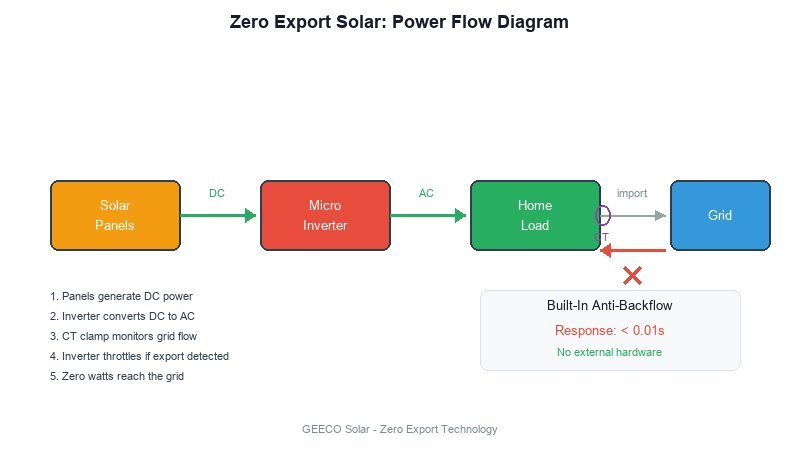
Figure 1: In a zero-export system, the inverter monitors the grid connection point and adjusts output so no surplus reaches the utility grid.
How Zero Export Technology Works
The Control Loop in Plain Language
A zero export system operates a continuous feedback loop that typically runs ten to fifty times per second:
- Measure — A current transformer (CT) clamp or smart meter at the main breaker measures real-time power flow at the point of common coupling (PCC).
- Compare — The controller compares measured export against the allowed threshold. Negative values mean export; positive values mean import.
- Signal — When export exceeds the threshold, the controller sends a command to the inverter via RS485 Modbus RTU, Modbus TCP, or a proprietary protocol.
- Throttle — The inverter reduces its AC output within 1–2 seconds, sometimes faster.
- Release — When on-site load increases, the inverter ramps back up.
External vs. Built-In Anti-Backflow
Traditionally, zero export is achieved with an external device: a CT clamp, a power analyzer, and a controller that talks to the inverter. Leading external solutions include Solar-Log, meteocontrol, Fronius Smart Meter, and the SMA Energy Meter. Hardware and installation typically add $500–$2,000 per system, and commissioning is error-prone. A reversed CT clamp or wrong Modbus register can turn a compliant system into a liability—as one Manchester installer discovered in March 2025 when a 250 kW system exported 18 MWh and triggered a £2,800 penalty.
GEECO's approach integrates the anti-backflow function directly into the inverter. Instead of relying on an external controller, the inverter itself measures grid flow and reacts in as little as 0.01 seconds. This eliminates extra wiring, removes a common failure point, and simplifies commissioning.
Global Regulations Driving Zero Export Adoption
Zero export requirements vary by country, grid operator, and system size. The table below summarizes the key rules in major solar markets as of 2026.
| Market | Regulation | Threshold / Requirement |
|---|---|---|
| UK | ENA EREC G99 | Above 3.68 kW per phase: export limitation scheme |
| UK | ENA EREC G98 | Up to 3.68 kW per phase: fixed export limit |
| Germany | VDE-AR-N 4105 | Above 4.6 kVA: 70% feed-in limit, smart meter required |
| Australia | AS/NZS 4777.2 | DNSP-dependent; some networks impose zero export |
| South Africa | Eskom NRS 097-2-1 | Above 16.5 kVA: zero export unless approved |
| Morocco | Law 13-19 | Zero export mandatory for all systems |
| Saudi Arabia | SEC guidelines | De facto zero export for residential and C&I |
| China | NEA 2025 guidance | Zero export for distributed C&I 6–50 MW |
| USA | IEEE 1547-2018 | Varies by utility; export caps common |
Sources: SurgePV zero-export configuration guide (2026); CapSolar Thailand zero-export overview (2026); EasySolar Malaysia regulatory summary (2026).
Technical Standards You Should Know
IEC 62109 and IEC 62116
IEC 62109 covers safety requirements for power conversion equipment in photovoltaic systems. It defines requirements for protection against electric shock, energy hazards, fire, and mechanical risks. IEC 62116 specifies the test procedure for anti-islanding protection, which remains mandatory even in zero-export systems because an inverter must still shut down safely if the grid disappears.
VDE-AR-N 4105 and AS/NZS 4777.2
VDE-AR-N 4105 is the German technical rule for connecting generation plants to the low-voltage grid. It sets the 70% feed-in limit and requires dynamic power control via a smart meter gateway. AS/NZS 4777.2 governs Australian grid connection and allows distribution network service providers to set flexible export limits, including zero export, to manage network constraints.
Why Certification Matters
A non-certified zero-export device may satisfy a homeowner in the short term, but it can void insurance, invalidate grid connection approval, and create liability if the system exports during a grid fault. Always verify that the inverter and any external controller carry the certifications required by the local market.
Real-World Performance: Does Zero Export Waste Energy?
Right-Sizing Is the Key
If a system is dramatically oversized relative to daytime consumption, a zero-export setting will curtail a lot of energy. A 50 kW array on a building that only uses 10 kW at midday will waste most of its output. However, when the array is sized to match the load profile, curtailment is limited to occasional sunny periods with unusually low demand.
Adding Batteries Changes the Equation
A battery energy storage system (BESS) can capture surplus that would otherwise be curtailed and discharge it in the evening. In zero-export markets, pairing solar with a small battery often improves project economics more than adding extra panels. This is one reason GEECO's product roadmap emphasizes micro-storage integration: it turns a zero-export constraint into a self-consumption advantage.
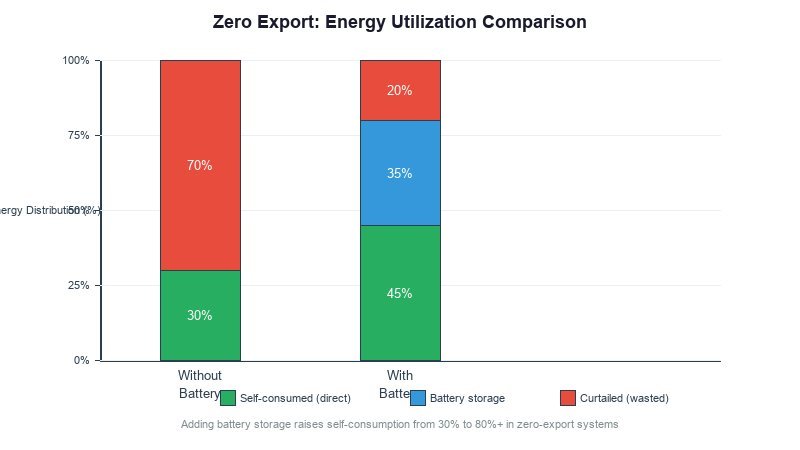
Figure 2: Adding micro-storage allows surplus solar to be used later rather than curtailed, improving zero-export economics.
Comparing Zero Export Solutions
Not all zero-export systems are equal. The table below compares the two main architectures.
| Feature | External Controller + Inverter | Built-In Anti-Backflow Inverter |
|---|---|---|
| Response time | 1–2 seconds | As fast as 0.01 seconds |
| Additional hardware | CT clamp, meter, controller, cabling | None; integrated into inverter |
| Typical cost | $500–$2,000 extra | Included in inverter cost |
| Commissioning complexity | High; CT orientation and Modbus settings critical | Low; plug-and-play setup |
| Failure modes | CT reversal, wiring faults, firmware mismatch | Reduced component count = fewer failure points |
| Best use case | Retrofit or large commercial systems | Residential, balcony, and OEM systems |
GEECO's Built-In Anti-Backflow Advantage
Designed for the Zero-Export Future
GEECO micro inverters were designed with zero export as a core feature, not an afterthought. The anti-backflow logic runs on the inverter's own controller, measuring grid flow directly and adjusting each panel's output independently. Because each panel has its own inverter, the system can curtail only the surplus modules while keeping others at full power—something a string inverter cannot do as gracefully.
Scenarios Where GEECO Shines
- Balcony solar in Germany and Austria: With legal limits of 600 W or 800 W, any export is risky. GEECO's built-in anti-backflow keeps the system compliant without external hardware.
- Apartment buildings with shared meters: When the utility does not allow net metering, a GEECO system can run self-consumption-only from day one.
- Commercial rooftops in export-constrained markets: Faster response means fewer grid-code violations and less curtailment oscillation.
- OEM and distributor brands: Built-in zero export simplifies the bill of materials and reduces support tickets.
For a closer look at GEECO's micro-inverter lineup, visit the high-efficiency micro inverter product page.
Industry Trends: Why Zero Export Is Growing in 2026
Grid Capacity Becomes the Bottleneck
According to Wood Mackenzie's first-half 2025 inverter market ranking, the top ten solar inverter manufacturers account for 71% of global market share. Huawei and Sungrow lead, followed by SMA, Fronius, and Ginlong/Solis. The same report notes that global inverter demand is expected to contract in 2025 and 2026 due to market uncertainty in China, Europe, and the United States. In a slower market, efficiency and compliance become more important than raw shipment growth.
Policy Moves Away from Net Metering
Several regions are reducing feed-in tariffs or requiring self-consumption-first operation. As net metering becomes less generous, the economic penalty for curtailing surplus shrinks, making zero export an easier sell. At the same time, stricter grid codes are pushing installers toward faster, more reliable anti-backflow solutions.
Appliance-ization of Solar
The industry is moving from custom-engineered rooftop installations to plug-and-play solar appliances. A balcony or portable solar system that requires an external meter and controller is no longer an appliance; it is a small engineering project. Built-in zero export is therefore a prerequisite for consumer-friendly solar products.
Installation Best Practices
Step-by-Step Commissioning Checklist
- Confirm the local grid code and export limit before ordering equipment.
- Size the array to match daytime consumption if zero export is required.
- Choose hardware with local certification (CE, VDE-AR-N 4105, AS/NZS 4777.2, UL 1741-SA, etc.).
- If using an external controller, verify CT orientation and meter compatibility.
- Configure the inverter to the required export limit and document the setting.
- Run a witness test with a known load to verify the system curtails correctly.
- Keep commissioning records, firmware versions, and calibration logs.
Common Mistakes to Avoid
- Reversing the CT clamp arrow (it should point toward the grid, not the load).
- Using incompatible Modbus registers between meter and inverter.
- Oversizing the array relative to daytime consumption.
- Ignoring firmware updates that affect export control behavior.
- Assuming zero export settings replace proper grid interconnection permits.
Is Zero Export Right for Your Installation?
Zero export is usually a constraint, not a choice. It becomes necessary when the grid operator, local regulation, or building management prohibits export. For homeowners who can sell surplus power, net metering may still deliver better returns. But as grids saturate and feed-in tariffs fall, zero-export self-consumption is becoming the dominant model in many markets.
A homeowner in Munich with a 600 W balcony system reported that built-in anti-backflow removed the need for any utility paperwork beyond the standard registration. The system generated an average of 520 kWh per year, consumed roughly 85% on-site, and never exported a measurable watt back to the grid. For an apartment dweller with no roof access, that is the difference between going solar and not going solar.
Final Thoughts and Next Steps
Zero export solar is not a compromise; it is a design condition that smart products can turn into an advantage. The key is choosing hardware that responds fast, certifies cleanly, and installs simply. External controllers remain valid for retrofits and large commercial projects, but for the growing residential, balcony, and OEM markets, built-in anti-backflow is the cleaner path.
If you are planning a zero-export installation, start by checking your local grid code, matching array size to daytime load, and selecting a certified inverter that supports anti-backflow at the source. GEECO's micro inverters are purpose-built for this future—combining panel-level optimization, sub-100-millisecond response, and the certifications needed for European, Asian, and Australian markets.
Ready to design your zero-export system? Explore GEECO's high-efficiency micro inverter and solar energy solutions to find the right fit for your home, apartment, or distribution project.