BMS and Micro-Storage: How Home Batteries Are Getting Smaller and Smarter
Why Micro-Storage (2-5 kWh) Is the Sweet Spot for Homes
Home battery storage used to mean a 10+ kWh wall-mounted monolith costing $10,000 or more. In 2026, that paradigm is shifting fast. The global residential lithium-ion energy storage market reached $18.93 billion in 2026 and is projected to hit $51.76 billion by 2032 at an 18.42% CAGR, but the fastest-growing slice isn't the large systems — it's compact 2-5 kWh "micro-storage" units that pair with balcony solar and small rooftop arrays.
The 500Wh-1,500Wh segment alone captured 50.7% of the portable home battery market in 2025, according to market research from PW Consulting. The reason is simple: most households need enough storage to cover evening consumption (refrigerator, lights, devices, TV) for 4-6 hours, not whole-home backup during a multi-day blackout. A 2-5 kWh battery handles that job at a fraction of the cost.
- Lower barrier: Micro-storage systems start at $1,500-3,000 vs $10,000+ for a Tesla Powerwall
- Faster payback: 3-5 year ROI vs 7-10 years for large systems
- Appliance-like installation: Plug-and-play units reduce labor costs by 30-40%
- Expandable: Start with 2 kWh, add modules as budget allows
BMS Explained: The Brain Inside Your Battery
A battery without a Battery Management System (BMS) is, as the engineering saying goes, "an unguarded liability." The BMS is the electronic brain that performs three critical functions simultaneously:
| Function | What It Does | Why It Matters |
|---|---|---|
| Protection | Cuts the circuit when any cell exceeds safe voltage (3.65V charge / 2.8V discharge), or when current/temperature hits danger levels | Prevents thermal runaway, fire, and permanent cell damage |
| Balancing | Corrects natural voltage drift between individual cells over hundreds of cycles | Without it, your weakest cell defines the entire pack's usable capacity |
| Monitoring | Tracks state of charge (SOC), state of health (SOH), per-cell voltage, temperature, and cycle count in real time | Lets you catch a failing cell before it takes down the pack |
Lithium iron phosphate (LFP) batteries have a uniquely flat discharge curve, which means a generic BMS will misread state of charge across the entire voltage plateau and trigger false low-voltage cutoffs with significant capacity remaining. A chemistry-specific BMS calibrated for LFP's 3.2V nominal voltage is essential.
LFP vs NMC: Why Lithium Iron Phosphate Wins for Home Use
The industry has decisively shifted from Nickel Manganese Cobalt (NMC) to Lithium Iron Phosphate (LFP) for residential storage. LFP now accounts for over 85% of new installations in China and 70-80% in the European Union as of 2025-2026. The reasons come down to safety, longevity, and cost.
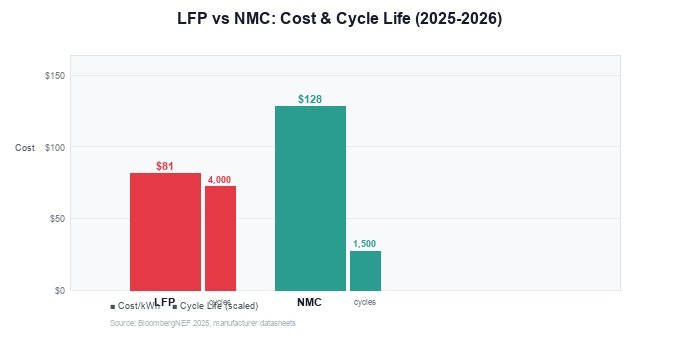
LFP cells cost $81/kWh in 2025 compared to $128/kWh for NMC, according to BloombergNEF. But the bigger story is cycle life: LFP delivers 4,000+ cycles vs NMC's 1,500, meaning a typical home battery lasts 10-15 years instead of 4-6. When you amortize cost over lifetime energy throughput, LFP is less than half the price per kWh delivered.
Safety is the other decisive factor. LFP's thermal runaway threshold is around 270°C vs NMC's 210°C, and LFP doesn't release oxygen during decomposition — making thermal runaway propagation far less likely. For a device installed inside or adjacent to living spaces, that margin matters.
How BMS Extends Battery Life: The Science of Cycle Optimization
A well-engineered BMS doesn't just protect your battery — it actively extends its life. The difference between a 6-year battery and a 12-year battery often comes down to BMS sophistication, not cell quality. Here are the key mechanisms:
- Depth of discharge management: The "20/80 rule" — keeping SOC between 20% and 80% — takes massive stress off lithium cells and can extend life by 5+ years. Smart BMS units enforce this automatically.
- Active cell balancing: Transfers energy between cells via capacitor/inductor circuits at 1-5A, correcting imbalance 10-50x faster than passive balancing (which bleeds energy as heat at 50-200mA). Active balancing is recommended for packs above 200Ah or daily deep cycling.
- Temperature control: At least 4 temperature probes per pack ensure the battery operates in the 15-25°C sweet spot. Every 10°C above 25°C roughly halves cycle life.
- Coulomb counting + voltage correction: Accurate SOC algorithms prevent deep discharge damage. Voltage-only SOC estimation on LFP's flat curve can be off by 15-20%.
Inverter communication is the final piece. A modern BMS shares real-time data (voltage, current, SOC, temperature, alarms) with the solar inverter via CAN bus or RS485, allowing the inverter to dynamically adjust charge/discharge limits. Without this integration, expect error codes, reduced power output, or forced shutdowns.
Integration: Inverter + BMS + Battery as a System
The biggest mistake homeowners make is buying a battery, an inverter, and a BMS separately and expecting them to work together. Integrated systems — where the inverter, BMS, and battery are designed as a single unit — deliver 3-5 percentage points higher round-trip efficiency than cobbled-together alternatives. DC-coupled hybrid inverter-battery systems now represent over 60% of new single-family home installations, achieving 92-96% round-trip efficiency.
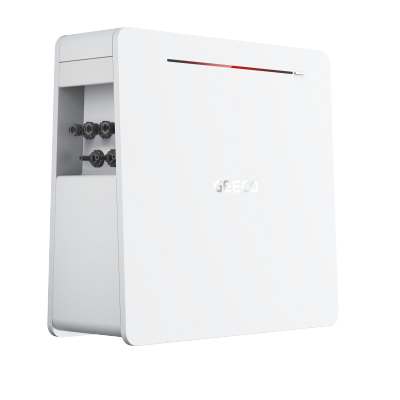
GEECO's approach integrates the micro inverter, BMS, and battery module into a single appliance-like unit. The built-in anti-backflow technology (0.01s detection) works in concert with the BMS to prevent grid feed without requiring external limiters. The Sub-1G communication protocol ensures the BMS stays connected to the monitoring app even when WiFi drops — a critical reliability advantage for safety systems.
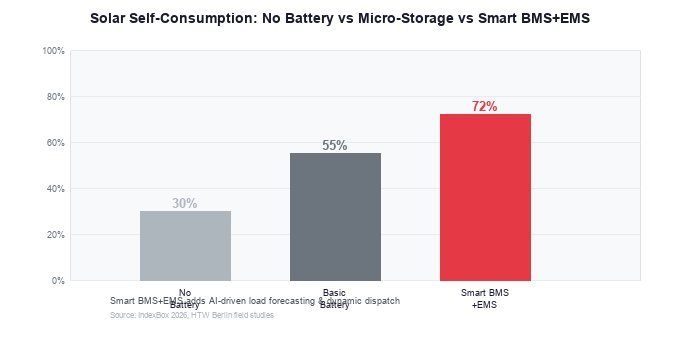
The result: solar self-consumption rates jump from ~30% (no battery) to 55% (basic battery) to 72%+ (smart BMS with AI-driven EMS), based on field studies from HTW Berlin and IndexBox 2026 market data. That 72% means nearly three-quarters of your solar generation is consumed on-site rather than exported at low feed-in tariff rates.
Real-World Economics: When Does Adding Storage Make Sense?
Consider a typical German household with a 800W balcony solar system generating about 900 kWh/year. Without storage, their self-consumption rate is roughly 30%, meaning 270 kWh is used on-site and 630 kWh is exported at Germany's reduced feed-in tariff of about €0.08/kWh. With electricity prices at €0.35/kWh, the math looks like this:
| Scenario | Self-Consumption | Annual Savings | Battery Cost | Payback |
|---|---|---|---|---|
| No battery | 30% (270 kWh) | €94 + €50 FiT | €0 | — |
| 2 kWh micro-storage | 55% (495 kWh) | €173 + €32 FiT | €1,200-1,800 | 3-5 years |
| Smart BMS + EMS | 72% (648 kWh) | €227 + €20 FiT | €1,500-2,200 | 3-4 years |
The incremental cost of upgrading from a basic battery to a smart BMS+EMS system (€300-400) pays for itself in 2-3 years through the additional 17 percentage points of self-consumption. In markets with Virtual Power Plant (VPP) programs — now active in China, Germany, and Australia — enrolled households earn $80-150/kWh annually, further improving economics.
What to Look for in a Micro-Storage System
If you're evaluating a home battery system in 2026, here's a practical checklist that cuts through marketing noise:
- Chemistry: Insist on LFP. It's safer, cheaper per lifetime kWh, and now the industry standard for residential use.
- BMS type: Look for active cell balancing (not just passive) and CAN/RS485 communication with your inverter.
- Integration: Prefer all-in-one systems (inverter+BMS+battery) over separate components for higher efficiency and simpler installation.
- Warranty: Minimum 10 years; premium systems offer 15 years. Check capacity retention guarantee (70% minimum at end of warranty).
- Communication: Sub-1G or hybrid wireless for reliability; WiFi-only systems are vulnerable to router reboots.
- Expandability: Modular designs let you start small (2 kWh) and add capacity later.
Honest caveat: Micro-storage isn't for everyone. If you live in an area with frequent multi-day outages, need whole-home backup (including HVAC), or have net metering credits that fully offset your export, a larger 10+ kWh system may be more appropriate. Micro-storage shines for daily self-consumption optimization, not extended blackout survival. Always calculate your specific consumption pattern and local tariff structure before deciding.
The trend is clear: batteries are getting smaller, smarter, and more integrated. A 2-5 kWh system with an intelligent BMS is no longer a compromise — for most urban and suburban homes with balcony or small rooftop solar, it's the optimal balance of cost, performance, and simplicity.