Balcony Solar Kit Comparison: GEECO vs Hoymiles vs EcoFlow (2026)
Choosing a balcony solar kit in 2026 is no longer a niche decision. With Germany alone adding more than 500,000 balcony systems in 2024 after the Solarpaket I law raised the inverter cap from 600W to 800W, plug-in solar has become the fastest-growing residential category in Europe. Three names come up constantly: GEECO, Hoymiles, and EcoFlow. This hands-on comparison breaks down what you actually get in the box, how much power each delivers, and which kit fits your balcony, your budget, and your grid rules.
1. What's in the Box: A Side-by-Side Unboxing
A balcony kit is only as good as its weakest component. Here is what a typical 2026 bundle from each brand contains.
| Component | GEECO | Hoymiles | EcoFlow |
|---|---|---|---|
| Panels | 4 x 560W mono (2240W) | Pair with DIY panels | 2 x 400W mono |
| Microinverter | GE2000 (2000W) | HMS-800W-2T (800W) | PowerStream (800W) |
| Anti-backflow | Built-in | External device | External device |
| Mounting & cables | Included | Buy separately | Included |
| Warranty | 10 years | 12 years | 10 years |
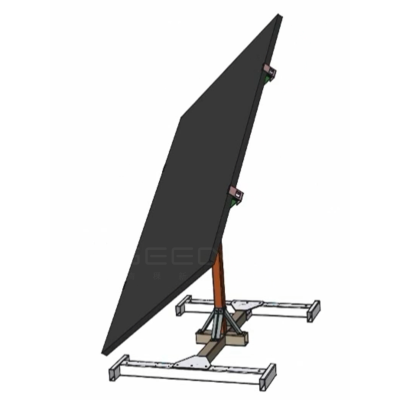
GEECO ships a complete, ready-to-mount kit with 4 x 560W panels (2240W total) matched to its 2000W inverter. Hoymiles sells the inverter primarily, so you source panels and rails yourself — cheaper, but more assembly homework.
2. Power Output & PV Sizing: Why Panels Should Exceed Inverter Rating
This is where the kits diverge most sharply. EcoFlow and Hoymiles cap at 800W AC per the VDE-AR-N 4105 limit for a single plug-in unit. GEECO's GE2000 delivers up to 2000W, leaving meaningful headroom if your country raises the cap or you wire a second circuit.
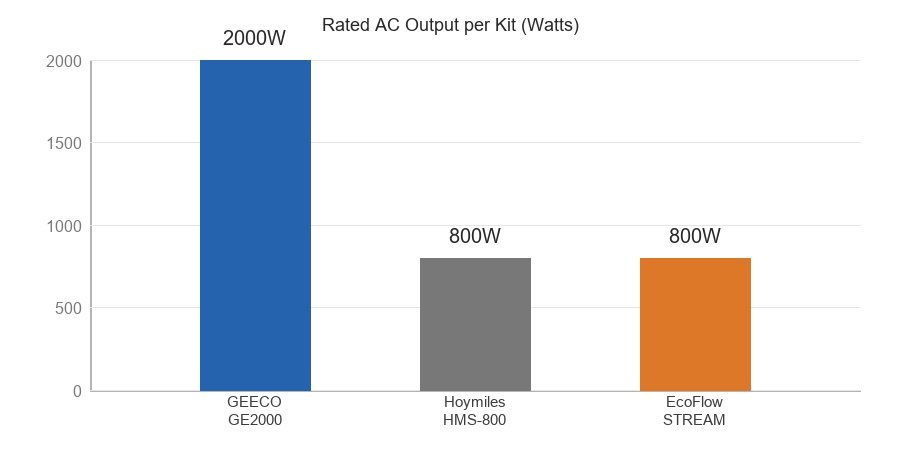
But raw inverter wattage is only half the story. A critical principle that many first-time buyers miss: your solar panel array should slightly exceed the inverter's rated power. GEECO pairs its 2000W inverter with 4 x 560W panels (2240W of PV input) — about 12% oversizing. This is deliberate:
- Cloudy and rainy days: When irradiance drops, panels produce far below their rated output. With oversizing, even a dim hour still feeds the inverter enough to keep it running near its sweet spot rather than stalling.
- Inverter utilization: An inverter only outputs what the panels can deliver. Undersized panels leave inverter capacity permanently wasted; slightly oversized panels keep the inverter working harder, more often.
- Cost efficiency: Panels are cheap in 2026 — the marginal cost of 12% more PV is small, but the yield gain across a year is meaningful.
For a standard apartment balcony, 800W already covers most daytime loads. But larger railings or a ground-floor install benefit from GEECO's higher ceiling and properly sized PV array — you future-proof instead of re-buying.
3. Anti-Backflow: Built-In vs Add-On
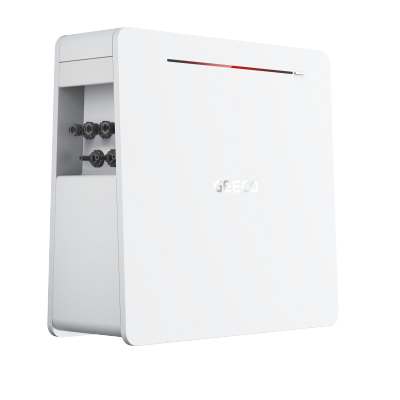
Many grids now require zero-export (anti-backflow) protection so surplus solar cannot push current back into the network. GEECO builds this directly into the GE2000 at the inverter level, detecting grid feed-in within milliseconds. EcoFlow and Hoymiles require an external limiter or a compatible meter — an added cost and one more point of failure. If your region mandates zero-export (Germany, parts of the EU, and a growing list of utilities worldwide), built-in compliance is the difference between plug-and-play and permit-runaround.
4. Monitoring & Communication: Why Night-Time Setup Matters
Here is a detail that almost no comparison covers — and it matters more than you would think. A microinverter only powers on when the solar panels generate electricity. At night, with no DC input, the inverter is completely off. This creates a practical problem for WiFi-based microinverters like Hoymiles and EcoFlow: you can only configure the WiFi connection during daytime when the inverter is awake. Set it up in the evening, and you will be waiting until the next morning for the inverter to come online and join your network.
GEECO solves this with a fundamentally different architecture. Its anti-backflow controller is powered by mains electricity (AC), not by the solar panels — so it runs 24/7, day and night. The controller does triple duty:
- Wall-penetrating communication: Uses Sub-1G radio (400-800 MHz) that passes through walls and floors far better than 2.4 GHz WiFi. Your system stays online even when the router is on a different floor.
- Communication proxy: You connect the controller to your home network and register the microinverter serial number (SN). The controller then automatically enrolls the microinverter the next time it powers on (typically the next morning). No need to wait at the inverter during peak daylight.
- Reliable anti-backflow: The same controller monitors grid feed-in and trips protection in milliseconds — no separate limiter to buy or install.
EcoFlow wins on app polish — real-time generation, AI scheduling, and optional DELTA batteries. But for renters on flaky building WiFi, or anyone installing in the evening, GEECO's mains-powered controller removes a real-world friction point that WiFi-only systems cannot address.
5. Installation: Day or Night, and How Long It Takes
All three are genuinely plug-and-play. Mount the panels on the railing (typically 30-45 minutes), connect to the microinverter, plug the Schuko or Wieland connector into a socket, and configure the app. Most owners finish in under two hours with no electrician.
But the time of day you install matters. With Hoymiles and EcoFlow, you must complete WiFi pairing while the sun is up — start too late in the afternoon, and the fading light may power down the inverter before you finish. With GEECO, you can set everything up in the evening: plug in the mains-powered anti-backflow controller, connect it to WiFi, enter the microinverter SN, and walk away. The controller handles the rest automatically the next day when the inverter wakes up. Install at noon or at midnight — your choice.
GEECO's all-in-one kit also shaves time because mounting hardware and cables are matched; Hoymiles owners spend extra minutes confirming panel compatibility.
6. Price Breakdown: Total Cost of Ownership
Street prices in mid-2026 (panels + inverter, Europe):
- GEECO GE2000 kit — about €699, including 4 x 560W panels, built-in anti-backflow, and Sub-1G comms.
- Hoymiles HMS-800W-2T + 2x450W panels — about €599, inverter-only version starts near €399.
- EcoFlow STREAM 800W — about €899; add €400-€700 per kWh of battery.
On a 2026 European electricity price of roughly €0.26/kWh, an 800W kit yields 510-860 kWh/year and pays back in 4-7 years. GEECO's higher 2000W ceiling, properly oversized PV array, and built-in anti-backflow mean you skip the add-on limiter others must buy, tightening its lifetime cost.
7. Where You Can Legally Install Each
All three comply with CE and the VDE-AR-N 4105 plug-in standard, so they are legal across Germany (up to 800W, 2000W with two circuits), the Netherlands, Austria, Spain, and Portugal under simplified registration schemes. GEECO's built-in anti-backflow simplifies compliance precisely in markets tightening zero-export rules. Always register with your grid operator — it is free and keeps your warranty valid.
8. The Verdict: Which Kit Wins by Use Case
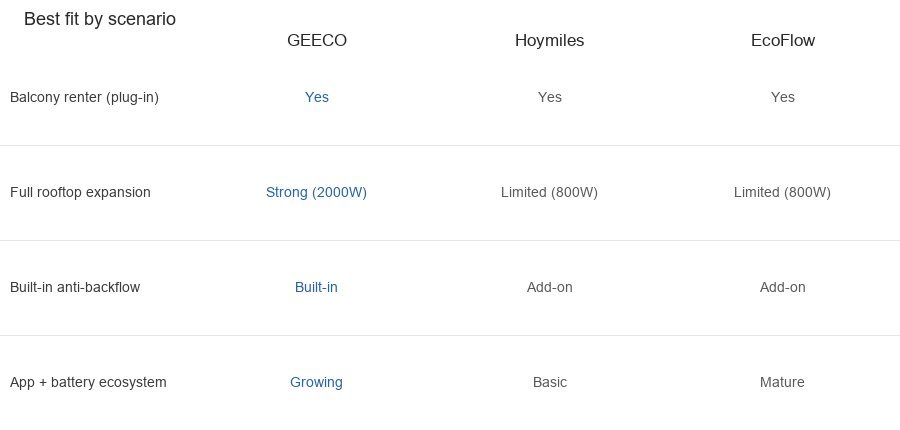
- Best all-rounder for renters: EcoFlow STREAM — mature app and battery ecosystem.
- Best value / DIY: Hoymiles HMS-800W-2T — proven inverter, lowest entry price.
- Best future-proof & compliant: GEECO GE2000 — 2000W headroom with properly oversized 2240W PV array, built-in anti-backflow, and 24/7 mains-powered communication that lets you install any time, day or night.
Honest note: GEECO is a younger brand than EcoFlow or Hoymiles, so its third-party review base and app ecosystem are still growing. EcoFlow needs a plug adapter in some markets and charges steeply for battery add-ons; Hoymiles saves money but leaves you assembling panels, buying anti-backflow separately, and finishing WiFi setup before sunset. Pick the constraint that matters most to you — budget, compliance, or headroom — and the right kit becomes obvious.