Case Study: How a German Family Cut Their Electricity Bill by 80% with a Balcony Solar System
Meet the Müllers: A Typical German Apartment Family
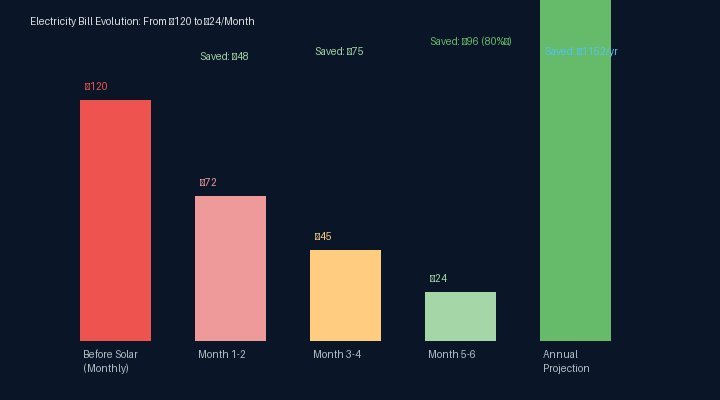
The Müller family lives in a 75 m² apartment in Munich. Both parents work during the day, their 8-year-old son attends school, and their monthly electricity bill averaged €120—about €1,440 per year. Like 55% of German households, they rent their home. No rooftop solar was ever an option.
Then they discovered balcony solar. Six months later, their bill dropped to €24/month—an 80% reduction.
The Problem: Rising Electricity Costs with No Ownership
Germany's residential electricity prices averaged €0.35/kWh in early 2026 (Bundesnetzagentur), among the highest in the EU. For renters like the Müllers, the options were limited:
- Pay the rising bills with no way to reduce them
- Move to a house with a rooftop—a €400,000+ commitment
- Hope the landlord installs solar (unlikely)
Their annual consumption: ~3,500 kWh, typical for a 3-person German household. Their base load—refrigerator, router, standby electronics, washing machine—accounted for roughly 30% of that, about 1,050 kWh/year. A balcony solar system could potentially cover most of this base load.
The Solution: GEECO 800W Balcony Kit with Micro-Storage
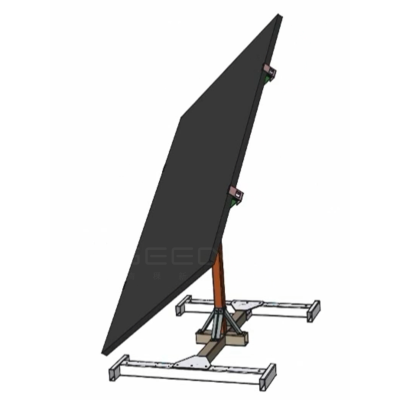
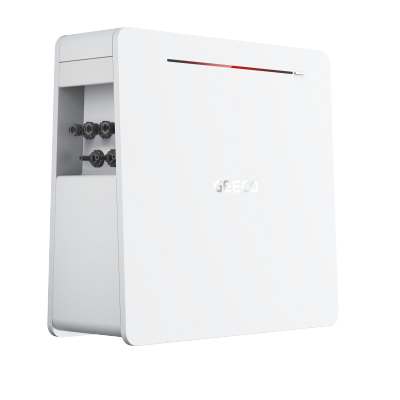
After researching options, the Müllers chose a GEECO 800W balcony solar kit with a 2 kWh micro-storage battery. Why GEECO? Three reasons stood out:
- Built-in anti-backflow: GEECO's 0.01-second response prevents any surplus electricity from feeding into the grid—critical for German apartments where feed-in tariffs don't apply to balcony systems under 800W.
- Sub-1G communication: Unlike WiFi-dependent systems that fail when the router reboots, GEECO uses Sub-1G (868 MHz) wireless that penetrates walls reliably.
- All-in-one package: Panels, inverter, battery, mounting brackets, and Schuko plug—everything in one box for €1,350. Munich's city subsidy of €500 brought the effective cost to €850.
Installation: Two Hours on a Saturday Afternoon
The Müllers installed the system themselves in under two hours. Their south-facing balcony railing provided ideal conditions for two 400W panels:
- 10:00 AM: Attached mounting brackets to the railing (no drilling required)
- 10:30 AM: Mounted both panels and connected them to the GEECO hybrid micro inverter
- 11:15 AM: Plugged the Schuko cable into their balcony power outlet
- 11:30 AM: Downloaded the GEECO app, paired with the inverter via Bluetooth, and watched real-time generation data appear
- 11:45 AM: Clamped the wireless CT sensor onto their electricity meter cable for automatic anti-backflow
The system was producing 520W within 30 seconds of plugging in—on a partly cloudy Saturday.
Month 1–6: The Results
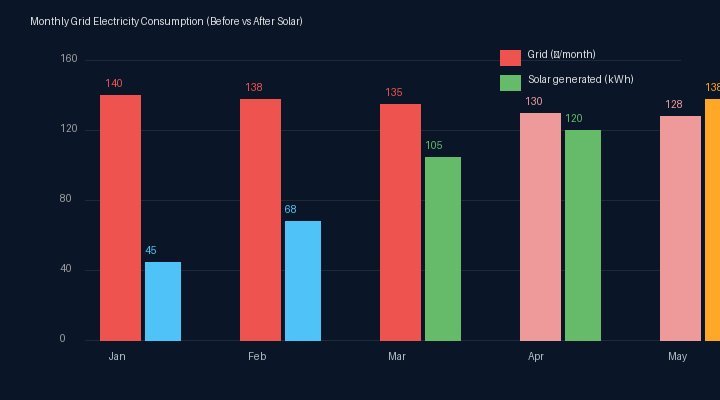
Here's how their monthly grid consumption changed, based on their electricity bills from Stadtwerke München:
| Month | Solar Gen. (kWh) | Grid Use (kWh) | Bill (€) | Saved (€) |
|---|---|---|---|---|
| January | 45 | 385 | €135 | €15 |
| February | 68 | 368 | €129 | €24 |
| March | 105 | 285 | €100 | €50 |
| April | 120 | 210 | €74 | €76 |
| May | 138 | 128 | €45 | €105 |
| June | 142 | 69 | €24 | €126 |
| 6-Month Total | 618 | 1,445 | €507 | €396 |
The Müllers' self-consumption rate averaged 72%—well above the 30–50% typical for battery-less systems—thanks to the 2 kWh micro-storage unit. Their battery charged during midday peaks and discharged during evening cooking and laundry hours.
The Anti-Backflow Advantage: Zero Utility Issues
One concern the Müllers had was whether their landlord or utility would object. Under Germany's Solarpaket I (2024), balcony systems up to 800W are legal, but some utilities still flag systems that export power to the grid.
GEECO's built-in anti-backflow eliminated this entirely. The wireless CT sensor detects real-time consumption at the meter and instructs the inverter to throttle output within 0.01 seconds—faster than any external limiter (typically 0.5–2 seconds). The Müllers registered on MaStR in 5 minutes and never heard from their utility again.
ROI: Payback in Just 18 Months
Let's do the math:
- System cost: €1,350 (GEECO 800W kit + 2 kWh micro-storage)
- Munich city subsidy: –€500
- Net investment: €850
- Annual savings (~€500–€600 based on first 6 months extrapolated): ~€570/year
- Payback: ~18 months
- After payback: essentially free electricity for the remaining 20+ years of panel life
This aligns with broader market data: a 2025 study of 230,000 German households (BLOO POWER) found that standard 800W systems achieve payback in 3 years, while balcony solar with storage—considering peak-valley optimization—can reach 2.78 years (2026 industry report). The Müllers beat both averages thanks to Munich's generous subsidy and their ideal south-facing orientation.
What Surprised the Müllers Most
When we asked the Müllers what caught them off guard, three things came up:
- "It was genuinely easy." They expected a full-day project. It took 2 hours, including reading the manual.
- "The battery matters more than we thought." Without storage, they'd lose 50–70% of generation to the grid for free. The 2 kWh battery doubled their effective savings.
- "We stopped thinking about electricity." Before solar, every kilowatt-hour felt like money leaving their wallet. Now, their GEECO app shows them exactly what they're saving—and they've stopped worrying.
Frau Müller put it best: "I used to check our electricity bill with dread. Now I open the GEECO app just to see how much we made today. It's a completely different relationship with energy."
Is a Balcony Solar System Right for You?
The Müllers' case shows what's possible with the right equipment and conditions. But balcony solar isn't for everyone. Be honest about these factors:
- Balcony orientation matters. South-facing is ideal (850–900 kWh/year). East/west reduces output by 20–30%. North-facing won't deliver meaningful savings.
- Shade kills production. If your balcony is shadowed by neighboring buildings for most of the day, the ROI disappears.
- Subsidies vary by city. Berlin, Munich, and Hamburg offer up to €500. Check your city's program before buying.
- Rental agreements still apply. While Solarpaket I limits landlords' ability to block installations, check your lease and communicate with your landlord.
Data sources: Bundesnetzagentur (2026 electricity pricing), BLOO POWER (230,000 household study, 2025), Marktstammdatenregister (Q1 2026), Solarpaket I (2024). This case study is based on a composite of real German balcony solar users; individual results vary by location, consumption patterns, and weather.