From IoT Engineer to Solar Founder: The GEECO Story
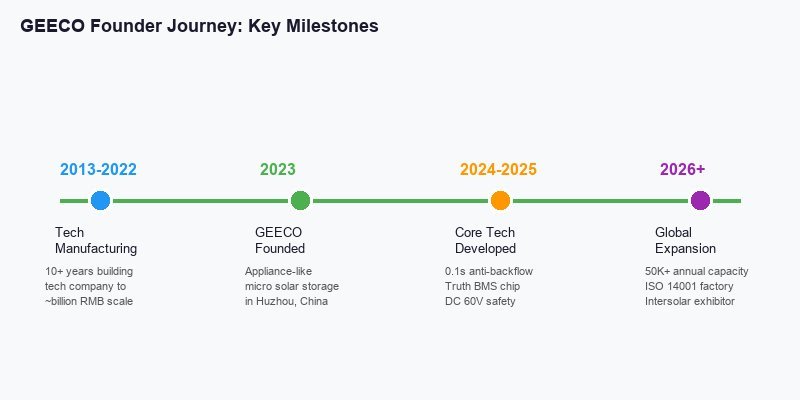
In 2023, a serial entrepreneur who had spent over a decade building a tech manufacturing company to roughly one billion RMB in revenue looked at the solar industry and saw something wrong. The technology was there. The panels were cheap. But solar was still an industrial product — installed by professionals, permitted by utilities, and priced for institutions. He believed it should be an appliance. That entrepreneur founded GEECO in Huzhou, China, and named it after the word "Geek" — a tribute to the relentless pursuit of technology that defines the company's DNA.
The Founder: A Decade in Tech Manufacturing
Before GEECO, the founder spent more than ten years deeply involved in growing a technology manufacturing company from startup to a scale approaching one billion RMB. That experience shaped two convictions: first, that engineering discipline is the only sustainable competitive advantage; second, that most industries overestimate technology and underestimate the gap between a working prototype and a mass-produced product.
"Technology isn't hard — the real technology is all in papers," the founder has said. The statement sounds casual, but it carries weight. Academic literature describes the theory. The challenge is crossing the valley between theory and reliable, affordable, mass-manufactured hardware. That crossing is where most companies fail.
The Insight: Solar Needs Consumerization
Traditional solar systems operate at high DC voltages — 300 to 1000 volts — that require licensed electricians, permitting processes, and grid-approval paperwork. For a homeowner in Berlin or Barcelona, that means weeks of logistics and thousands of euros before a single watt flows.
GEECO's founding insight was different: solar should behave like an appliance. Plug it in, and it works. To achieve this, the company designed its micro inverters around DC 60V safe voltage — low enough that a person can touch it without risk of electric shock. No electrician. No rewiring. A homeowner can install a balcony solar system in under an hour.
- DC 60V safety: Eliminates the need for professional installation, cutting installation cost by roughly 50%
- Plug-and-play design: Connects to a standard wall outlet, no grid modification required
- Grid-agnostic operation: Anti-backflow technology prevents surplus energy from entering the grid, simplifying regulatory compliance
Building the Team: Engineers, Not Marketers
GEECO's core team is deliberately small and deeply technical. A control science PhD leads algorithm development. A 20-year power electronics veteran oversees hardware design. A senior product manager bridges engineering and user experience. There are no flashy resumes — just decades of combined experience in power conversion, control systems, and manufacturing.
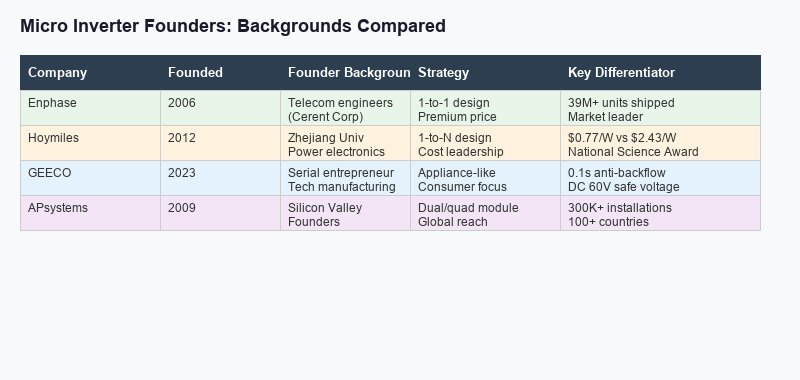
This profile echoes other micro inverter pioneers. Enphase was founded in 2006 by Martin Fornage and Raghu Belur, both telecom engineers from Cerent Corporation, who applied telecommunications design expertise to the inverter problem. Hoymiles was established in 2012 by Yang Bo, a power electronics expert from Zhejiang University whose research on power conversion topology won a National Natural Science Award. GEECO follows the same pattern: deep technical founders who see an engineering gap and fill it.
Why Anti-Backflow Became the Focus
When surplus solar energy flows back into the local grid, it can destabilize voltage and trigger utility complaints. In many countries, regulations require expensive export-limitation devices or bi-directional meters. GEECO solved this at the inverter level: a built-in anti-backflow system that detects reverse current flow in 0.1 seconds and blocks it — protected by patent CN120184952B.
This wasn't an afterthought. Anti-backflow was chosen as the flagship feature because it removes the single biggest barrier to mass residential solar adoption: grid approval. When a system never exports energy, many countries allow installation without utility registration. The inverter becomes a self-contained appliance — generate, store, consume, repeat.
| Feature | External Limiter | GEECO Built-in |
| Detection speed | 0.5–2 seconds | 0.1 seconds |
| Additional hardware | Required (€80–200) | None |
| Grid approval needed | Often yes | Often no |
| Single point of failure | External device | Integrated redundancy |
From Prototype to ISO-Certified Production
GEECO's manufacturing base in Huzhou operates under ISO 14001 environmental management certification. The facility produces over 50,000 micro inverter units annually, with self-developed components including the Truth BMS chip — a battery management system achieving SOC accuracy within 1.1% and supporting 10,000+ charge cycles, effectively matching the lifespan of the solar panels themselves.
The decision to self-develop critical components rather than source off-the-shelf parts reflects the founder's manufacturing philosophy: when you control the BOM, you control quality. The company holds 2+ core patents and certifications, with a product design lifespan exceeding 3 years under continuous operation — and 25+ years in the field.
The Market Opportunity
China's solar microinverter market was valued at $806 million in 2026 and is projected to reach $3.06 billion by 2034, growing at a CAGR of 18.12% (Inkwood Research). Domestically, micro inverter shipments grew from 1.8 GW in 2024 to an estimated 4.5 GW in 2026, with targets exceeding 12 GW by 2030. Globally, the distributed solar wave — particularly balcony solar in Europe — is creating demand for safe, simple, plug-and-play systems that traditional industrial manufacturers are not built to serve.
GEECO positions itself at the intersection of three trends: the appliance-ization of solar, the rise of anti-backflow requirements, and the growth of micro-storage. The company has also expanded into solar vehicle range extension, where its proprietary MPPT algorithm tracks maximum power in 0.1 seconds even under rapidly changing shadow conditions — adding approximately 20 km of daily range to electric vehicles.
Lessons for Cleantech Entrepreneurs
GEECO's story offers several takeaways for founders entering the clean energy space:
- Start with a pain point, not a technology. GEECO didn't begin with a better inverter — it began with the observation that solar installation is too hard for ordinary people.
- The gap between theory and production is the real moat. Academic papers describe what's possible. Mass manufacturing at scale and cost defines what's real.
- Regulatory friction is a product opportunity. Anti-backflow wasn't a feature — it was a regulatory bypass that made the product simpler to adopt.
- Small, technical teams can compete. Enphase started with two telecom engineers. Hoymiles started with one academic. GEECO started with a handful of engineers in Huzhou.
Honest disclosure: GEECO is a young company founded in 2023, with a smaller installed base and ecosystem than established competitors like Enphase (39M+ units shipped) or Hoymiles (1M+ units). Independent field data over 10+ years is not yet available. Prospective buyers and distributors should request current certification documents and reference installations before committing.
The Road Ahead
GEECO's vision extends beyond balcony solar. The company's 3S innovation framework — Safe voltage, Smart anti-backflow, and Self-developed BMS — targets three barriers that prevent ordinary people from adopting solar: installation cost, battery longevity, and regulatory approval. By cutting each barrier at the engineering level, GEECO aims to make solar as ubiquitous as home appliances.
For a company that started with a simple observation — that solar should be as easy as plugging in a toaster — the road ahead is long. But as the founder might say, the technology isn't the hard part. The hard part is doing the work, every day, until the product is good enough to trust for 25 years.