How to Choose the Right Micro Inverter for Your Solar Project
Start With Your Panels: Wattage, Voltage, and Compatibility
Before you browse inverter catalogs, pull out your panel datasheet. The three numbers that matter most are rated power at Standard Test Conditions (STC), open-circuit voltage (Voc), and short-circuit current (Isc). In 2026, residential panels typically range from 400W to 620W — TOPCon modules dominate the 500–620W range, while premium IBC panels push past 600W. Your micro inverter must handle the panel's peak DC output on a cold, bright day when real output can exceed STC ratings by 5–15%. A mismatch here means either clipping (lost energy) or wasted money on oversized hardware.
The safe DC-to-AC ratio sits between 1.10 and 1.30. Below 1.05, you're paying for AC capacity the panel can never fill. Above 1.35, you start clipping meaningfully on sunny days — and that clipped energy is permanently lost, not stored or shifted.
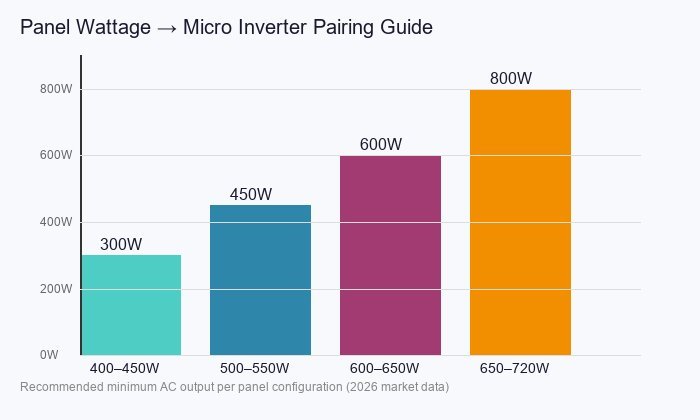
| Panel Power (W) | Recommended Inverter AC (W) | DC-to-AC Ratio | Example Models |
|---|---|---|---|
| 400–450 | 300–366 | 1.20–1.33 | Enphase IQ8A, Hoymiles HMS-400 |
| 500–550 | 450–600 | 1.11–1.22 | GEECO GE600, APsystems DS3 |
| 600–650 | 600–800 | 1.00–1.08 | GEECO GE2000, Hoymiles HMS-2000 |
| 650–720 | 800–1100 | 0.81–0.90 | GEECO GE2000 dual, Enphase IQ8P |
Single vs Dual vs Quad Channel: Which Architecture Fits Your Project
Micro inverters come in three architectures. Single-input units pair one inverter per panel — maximum granularity, panel-level MPPT, and easiest troubleshooting. Dual-input units (like APsystems DS3 or GEECO GE2000) handle two panels with independent MPPT per channel, cutting hardware count while preserving per-panel optimization. Quad-input units (Hoymiles HMS-2000-4T) serve four panels from one enclosure — lowest cost per watt but shared monitoring granularity.
- Single (1:1): Best for mixed orientations, shade-heavy roofs, or when you need per-panel diagnostics. Highest redundancy — one failure affects only one panel.
- Dual (2:1): Sweet spot for most residential systems. Two independent MPPT channels mean different panel models or orientations coexist without performance loss. The dual-module micro inverter market is projected to grow from $2.13B in 2025 to $6.45B by 2032 (CAGR 17.15%), reflecting strong global adoption.
- Quad (4:1): Best economics for large, uniform rooftops. The quad-in market is expanding at 17.3% CAGR toward $21.85B by 2034. Ideal when all panels share the same orientation and minimal shading.
For balcony solar and small residential systems, dual-channel is typically the right choice — it balances cost, flexibility, and the monitoring detail most homeowners actually need.
Grid Requirements: Voltage, Frequency, and Anti-Islanding
Your micro inverter must match your local grid exactly. In North America, that's 120V/240V at 60Hz. In Europe and most of Asia, it's 230V at 50Hz. Every certified micro inverter includes anti-islanding protection — it disconnects within milliseconds if the grid goes down, preventing dangerous backfeed. Look for certification marks matching your region: UL 1741 (US), VDE-AR-N 4105 (Germany), G98/G99 (UK), IEC 62109 (international).
Some grids now require rapid shutdown capability (NEC 2017/2020 in the US). Micro inverters inherently comply because DC voltage stays below 60V at the module level — there's no high-voltage DC string to manage. This built-in compliance eliminates the need for external rapid shutdown devices that string inverter systems require.
Environmental Conditions: IP Rating, Temperature, and Humidity
Your inverter lives outdoors for 20+ years. The IP rating tells you how well it resists water and dust ingress. IP65 handles rain from any direction but can't survive submersion. IP67 withstands temporary immersion — essential for regions with heavy rain, snow, or coastal exposure. IP68 is overkill for residential inverters. GEECO's GE2000 carries IP67, rated for full outdoor deployment without additional weatherproofing.
Temperature range matters more than most buyers realize. Check the operating range on the datasheet — quality inverters specify -40°C to +65°C. In hot climates, inverters mounted directly under panels can exceed 60°C. In cold regions, startup at -25°C must be reliable. A 2025 IRENA study found that 23.7% of outdoor inverter failures correlate with inadequate environmental protection, particularly in tropical and coastal zones where 68% of installations need at least IP65.
Monitoring: App, Web, and API Access
Panel-level monitoring is a primary advantage of micro inverters. Enphase's Enlighten platform leads with real-time per-panel data, consumption tracking, and proactive fault alerts. Hoymiles' S-Miles Cloud provides solid generation data but fewer diagnostic features. GEECO's self-developed EMS app offers real-time monitoring, AI-driven consumption predictions, and Sub-1G communication that stays connected even when your home WiFi drops.
For homeowners, a good monitoring app means you can spot a single underperforming panel from your phone instead of guessing which string is dragging production. For distributors and installers, API access enables fleet management across dozens of customer systems. Ask whether the platform supports third-party integration before committing.
Anti-Backflow: External Limiter or Built-In Protection
In many European countries, balcony and residential solar systems must prevent surplus energy from flowing back into the grid. Traditionally, this requires an external export limitation device — an extra box that costs $50–150 and adds wiring complexity. GEECO's GE2000 integrates anti-backflow at the inverter level with 0.01-second detection, detecting surplus generation and throttling output before any energy leaves your home circuit. This eliminates the external device entirely.
The practical difference: with an external limiter, response time is typically 0.5–2 seconds, during which energy can still backfeed. With GEECO's integrated approach, detection and throttling happen in 10 milliseconds — fast enough that your utility meter never registers export. For German balcony solar under the 800W Solarpaket I regulation, this built-in compliance simplifies both installation and regulatory approval.
Warranty and Support: What to Look For Beyond the Spec Sheet
Warranty length is a proxy for manufacturer confidence. Enphase offers 25 years — industry-leading. Hoymiles provides 12 years standard, extendable to 25. APsystems covers 10–25 years depending on model. GEECO backs the GE2000 with a 12-year standard warranty, extendable to 25 years.
But warranty length alone doesn't tell the full story. Ask three questions: (1) Does the warranty cover both parts and labor? (2) Is there a local support team or just an overseas call center? (3) What's the replacement process — can you swap a unit yourself or does it require a certified installer? A 25-year warranty with no local support infrastructure is less valuable than a 12-year warranty with responsive regional service. NREL data shows that micro inverter systems produce 5–25% more energy than string inverters in shaded conditions — but only if failing units get replaced promptly.
Your Step-by-Step Selection Guide
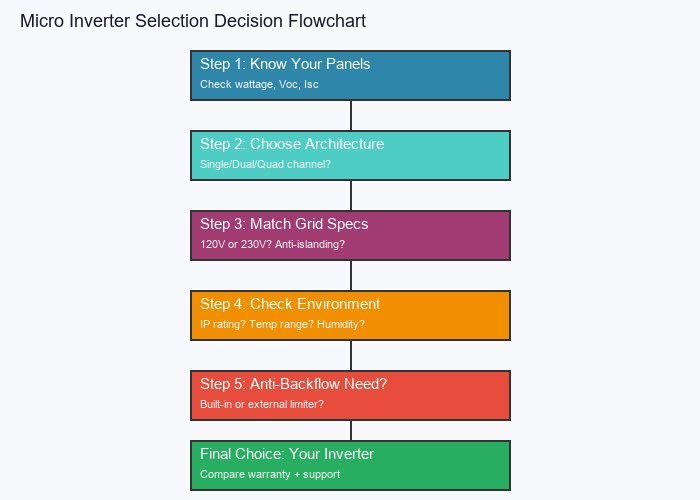
Here's the condensed decision process that works for most residential and balcony solar projects in 2026:
- Check your panels — note STC wattage, Voc, and Isc from the datasheet.
- Choose architecture — single for complex roofs, dual for most residential, quad for large uniform arrays.
- Match grid specs — confirm voltage, frequency, and required certifications for your country.
- Evaluate environment — IP67 for outdoor deployment, -40°C to +65°C operating range.
- Decide on anti-backflow — built-in (GEECO) eliminates extra hardware; external limiter adds cost and wiring.
- Compare warranty + support — length matters, but local service infrastructure matters more.
The global micro inverter market is growing at 17–24% CAGR across single, dual, and quad segments — reflecting the shift toward panel-level power electronics in both residential and commercial solar. As panel wattages climb past 600W and regulations tighten around rapid shutdown and anti-backflow, choosing a micro inverter that handles these requirements natively — rather than through add-on devices — saves cost, simplifies installation, and reduces long-term maintenance complexity. GEECO's GE2000 exemplifies this integrated approach: dual-channel MPPT, IP67 enclosure, Sub-1G communication for reliable monitoring, and built-in anti-backflow that meets European regulatory requirements without external hardware.
Honest limitation: No single inverter is optimal for every scenario. If your roof is perfectly uniform with zero shade and you don't need panel-level monitoring, a quad-input unit may offer better economics. If you're in a market where net metering pays you for surplus generation, anti-backflow isn't needed at all — and in that case, a conventional micro inverter without export limiting may be simpler. Match the tool to the job, not the brand to the budget.