Solar Energy in 2026: 5 Trends Reshaping Home Power Generation
Home solar is no longer just panels on a roof. In 2026, the residential market is being reshaped by five converging trends that make solar smaller, smarter, safer, and more personalized. Together they are expanding the addressable market from homeowners with south-facing roofs to renters, apartment dwellers, and small distributors who can build their own brands.
This article breaks down each trend, what it means for buyers, and how GEECO is positioning its product line at the intersection of all five.
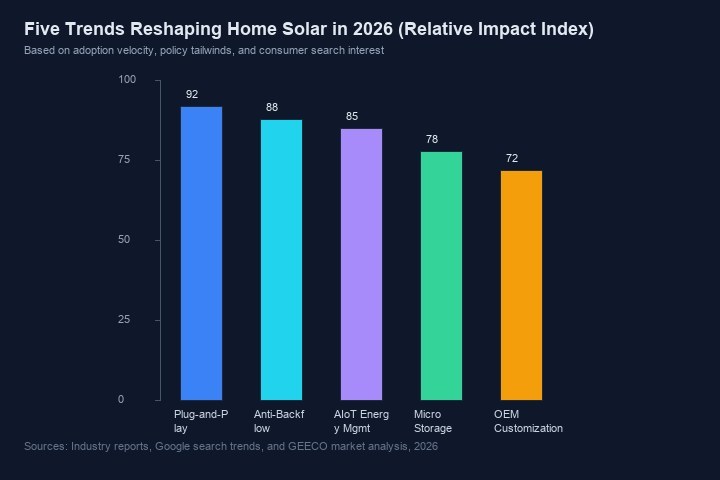
Trend 1: The Appliance-ization of Solar
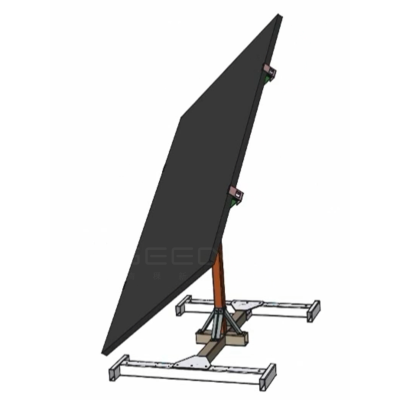
The first and most visible trend is the shift from construction project to consumer appliance. Plug-and-play balcony systems, portable solar kits, and pre-configured micro-inverter bundles now ship in boxes that look more like kitchen appliances than industrial hardware. This matters because it removes the two biggest barriers to adoption: professional installation and long permitting timelines.
In Germany, the 800W balcony solar rule lets tenants plug a system into a wall socket after a simple online registration. In the UK, 2026 is shaping up to be the strongest year on record for residential solar, with over 269,000 installations in 2025 and two million systems passed by March 2026. Many of these new buyers are not traditional rooftop customers; they are renters and flat owners who want a low-risk entry point.
The result is a new buyer psychology. People compare solar to a dishwasher or heat pump: they want unboxing, setup in an afternoon, and an app that tells them if everything is working.
Trend 2: Anti-Backflow Becomes the Default
As solar penetrates apartment buildings and dense urban grids, utilities are getting stricter about surplus power flowing back into the network. Zero-export or anti-backflow rules are now standard in Germany, Austria, and a growing list of markets. The old workaround was an external export-limitation box with current clamps and extra wiring. It worked, but it added cost, failure points, and paperwork.
The new standard is built-in anti-backflow at the inverter level. GEECO's micro inverters detect reverse power flow in under 0.01 seconds and throttle output to match real-time household demand. That speed eliminates the brief export spikes that can trigger grid-operator complaints or inverter shutdowns, and it removes the need for separate hardware.
For distributors, this is a supply-chain simplification. One SKU can satisfy German VDE-AR-N 4105, Austrian E-Control requirements, and other zero-export markets with minor firmware settings.
Trend 3: AIoT Energy Management Goes Mainstream
Third, solar is becoming software-defined. In 2026, smart energy management systems use AI and IoT to predict generation, forecast consumption, and automatically shift loads to the cheapest or greenest hours. A battery can see that tomorrow will be cloudy and choose to charge overnight at off-peak rates. An inverter can throttle output when the EV is already full and the grid is congested.
This is not a luxury feature anymore. In markets with time-of-use pricing, dynamic scheduling can improve project economics by 10-20%. For homeowners, the value is peace of mind: the system optimizes itself without requiring them to become energy traders.
GEECO's self-developed EMS combines local edge control with cloud analytics. The on-device layer keeps critical safety decisions fast and private; the cloud layer learns from fleet-wide patterns to improve predictions.
Trend 4: Micro-Storage Becomes Standard
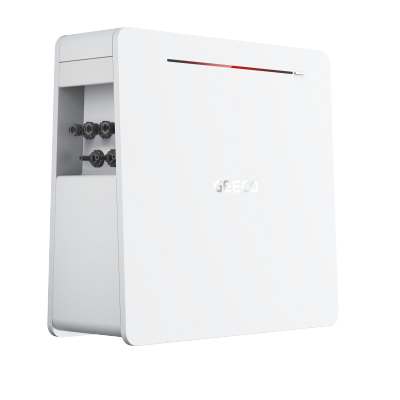
Fourth, storage is shrinking. Instead of a single large garage battery, 2026 is seeing modular micro-storage units sized for balcony and small rooftop systems. A 2-5 kWh lithium iron phosphate battery can store afternoon solar for evening use, ride through short outages, and smooth out daily consumption curves without requiring a dedicated electrical room.
The growth numbers are striking. Global residential battery capacity paired with solar has climbed from roughly 14 GW in 2022 to an estimated 74 GW in 2026. Much of that growth is coming in smaller form factors that match the plug-and-play aesthetic of the panels they serve.
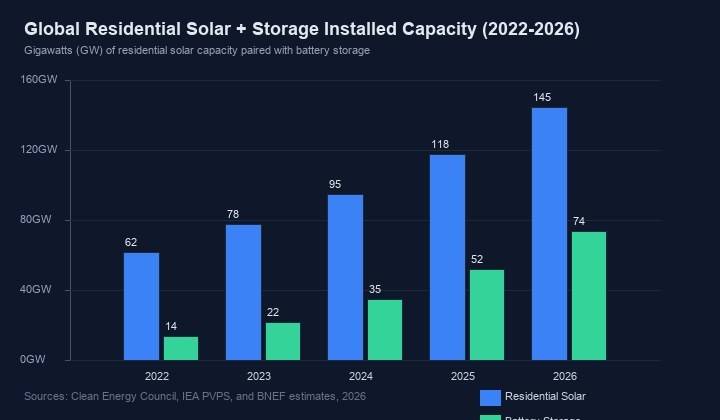
Micro-storage also changes the payback math. In markets where net metering is being phased out, self-consumption becomes the only path to strong returns. A small battery makes that path practical.
Trend 5: OEM Customization Drives Brand Proliferation
Fifth, the solar supply chain is becoming more modular and brandable. Distributors, installers, and energy retailers no longer need to design hardware from scratch. They can work with OEM partners to customize firmware, enclosures, app branding, and packaging, then launch their own product lines in months rather than years.
This trend is particularly strong in Europe, where local language support, local certifications, and local warranty logistics matter. An OEM partner that already holds CE, VDE, and grid compliance certifications can dramatically shorten a new brand's time to market.
GEECO's OEM program is built around this idea: a shared hardware platform with flexible software, branding, and certification support so partners can focus on customer acquisition rather than factory management.
Who Benefits and What to Watch
| Buyer | Biggest Benefit | What to Watch |
|---|---|---|
| Renters / apartment dwellers | Low-cost, no-permit entry to solar | Lease rules, orientation, anti-backflow compliance |
| Homeowners | Higher self-consumption, lower bills | Battery sizing, net metering changes |
| Distributors | Faster brand launch with OEM support | Certification transfer, warranty terms |
| Installers | Shorter install time, fewer callbacks | Training on app and diagnostics |
This table is a decision aid, not a substitute for local grid rules or professional advice. Every market has its own registration, insurance, and interconnection requirements.
GEECO is building a product portfolio that sits at the center of these trends: plug-and-play balcony systems with built-in anti-backflow, AIoT energy management, modular micro-storage, and an OEM platform that lets partners customize branding and certifications. The unifying idea is that solar should behave like a consumer appliance, not an industrial project. For homeowners, that means lower friction. For distributors, it means faster time to market. For the grid, it means millions of small, controllable, self-consumption assets.