Sustainable Manufacturing: Inside GEECO's ISO 14001 Certified Factory
Why ISO 14001 Matters in Solar Manufacturing
Solar products are supposed to clean up the energy system — but making them can be dirty if factories cut corners. ISO 14001 is the international standard for environmental management systems, and in 2026 it was updated to ISO 14001:2026 with stronger requirements for climate action, life-cycle thinking, and supply-chain accountability (ISO, 2026). For solar buyers, that certification is one of the few independent signals that a manufacturer treats sustainability as a system, not a slogan.
The shift is economically meaningful, not just ethical. Wood Mackenzie's 2026 global inverter manufacturer ranking gives ESG initiatives a 30% weight — higher than after-sales service (15%) or financial conditions (5%). Six of the top ten inverter makers now hold an EcoVadis silver or higher sustainability rating, and eight reinvest more than 6% of revenue into R&D (PV Magazine, 2026). In other words, environmental discipline and long-term product quality are increasingly the same conversation.
What ISO 14001:2026 Actually Requires
The 2026 revision builds on ISO 14001:2015 but adds sharper teeth in four areas. Manufacturers must now explicitly identify climate-related risks and biodiversity impacts, extend life-cycle thinking across the full value chain, embed environmental considerations into change management, and demonstrate stronger leadership accountability (TÜV Austria, 2026). It is no longer enough to manage waste inside the factory walls.
- Climate integration: Objectives must include greenhouse-gas reduction and climate-adaptation planning.
- Life-cycle perspective: Impacts from raw-material sourcing through end-of-life disposal must be evaluated.
- Supply-chain controls: "Externally provided processes" must meet the same environmental criteria as in-house work.
- Leadership accountability: Top management must actively integrate environmental decisions into strategic planning.
Inside the Factory: From PCB to Finished Inverter
A micro inverter is a surprisingly complex device. It contains a printed circuit board, power semiconductors (MOSFETs and IGBTs), magnetics, capacitors, a sealed enclosure, and firmware. The GEECO factory processes each unit through six main stages before it leaves the building.
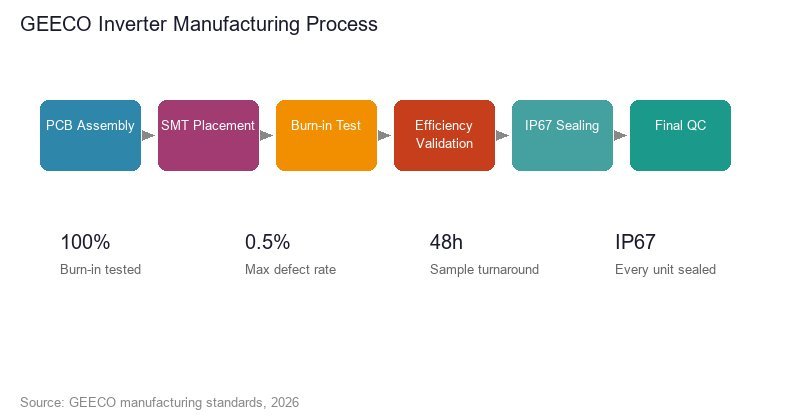
The first stage is PCB assembly, where surface-mount components are placed by machine at speeds of 30,000 to 60,000 components per hour. The second stage is reflow soldering, followed by optical inspection to catch placement errors. From there, each board goes to functional testing, firmware flashing, and a burn-in period that simulates high-temperature operation. Only then does the unit move to final assembly, IP67 sealing, and packaging.
Quality Control: How Every Inverter Is Tested Before Shipping
Reliability in the field starts with discipline in the factory. GEECO's test sequence is designed to catch defects before a customer ever sees them:
| Test Stage | What It Checks | Standard / Target |
|---|---|---|
| AOI after SMT | Component placement and solder joints | 100% inspection, <0.3% false reject |
| In-circuit test | Passive and active component values | All critical nets |
| Functional test | MPPT efficiency, output waveform, protections | ≥97% MPPT efficiency |
| Burn-in | Thermal stress and early-life failures | 48 hours at 45°C ambient |
| IP67 sealing test | Water and dust ingress protection | 1 meter submersion, 30 minutes |
Industry data from IRENA (2024) suggests that outdoor inverter failure rates can reach 23.7% over a system's lifetime when environmental stress and installation quality are not controlled. Burn-in testing and sealed enclosures are two of the most cost-effective ways to push that number down.
Environmental Practices: Beyond Compliance
ISO 14001 is a management system, not a performance scorecard. A factory can be certified and still generate significant waste. The difference shows up in the operational targets a company sets beyond the standard. GEECO's environmental program focuses on five measurable areas:
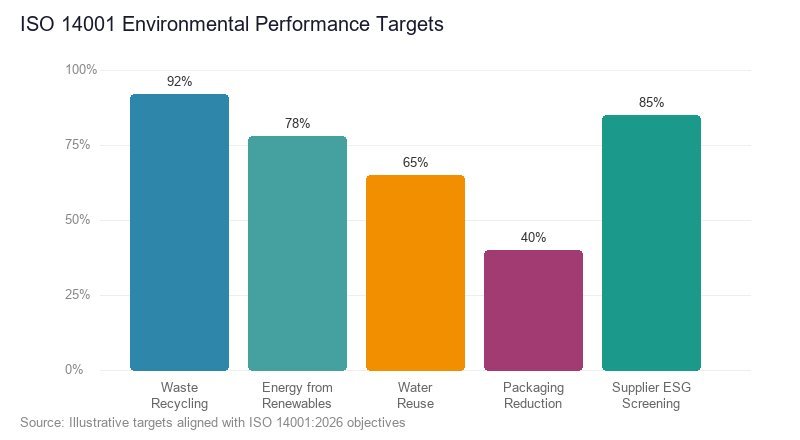
- Waste recycling: Target of 92% diversion from landfill, including metal reels, cardboard, and defective PCBs sent to certified e-waste recyclers.
- Renewable energy: Factory roof solar plus green-power purchase agreements target 78% renewable electricity.
- Water reuse: Closed-loop cooling and cleaning systems aim for 65% water recycling.
- Packaging reduction: Transition to recycled cardboard and minimized single-use plastic, targeting 40% material reduction per unit.
- Supplier ESG screening: 85% of critical suppliers evaluated against environmental and social criteria.
The Self-Developed Advantage: Why In-House Components Matter
A large part of manufacturing quality is decided at the design stage. GEECO develops its own control algorithms, communication protocol, and key hardware platforms in-house. That matters for environmental performance in two ways. First, in-house design allows the team to optimize component count and board size, which reduces material use and waste. Second, it enables tighter integration between the inverter and the monitoring system, which improves field diagnostics and reduces unnecessary returns.
China remains the world's largest production base for solar inverters, supplying over 60% of global demand (MySolarQuotes, 2026). The competitive advantage of leading Chinese manufacturers is no longer just cost — it is the speed of iteration, flexible customization, and vertically integrated supply chains (MespalSolar, 2026). In-house development is what makes that flexibility possible without sacrificing quality control.
Worker Welfare and Social Responsibility
An environmental management system that ignores people is incomplete. GEECO's factory operates under ISO 14001 and aligns with ISO 45001 occupational health and safety principles. Practical measures include climate-controlled assembly areas, ESD protection on all production lines, regular safety training, and documented working-hour limits. While ISO 14001 does not directly audit labor conditions, the discipline of a certified management system tends to create the documentation and accountability culture that supports broader social compliance.
The solar industry's global expansion depends on a stable manufacturing workforce. SEIA's supply-chain dashboard estimates that U.S. solar manufacturing alone will create 48,800 jobs from announced investments, growing to 100,000 by 2033 (SEIA, 2026). Treating factory workers as a long-term asset rather than a variable cost is both an ethical and a business imperative.
What This Means for Your Solar System
For homeowners and distributors, a manufacturer's environmental certification is a proxy for something more concrete: consistency. A factory disciplined enough to track waste streams, audit suppliers, and test every unit is also a factory less likely to ship inverters with latent defects. The 25-year lifespan of a solar system makes that consistency valuable.
GEECO's ISO 14001 certification is not a guarantee that every installation will be trouble-free. No certification can promise that. But it is an independent checkpoint that the company has built environmental thinking into its operations — from the components it sources to the tests it runs before boxing a unit. In a market where inverter quality ranges from premium to disposable, that kind of transparency is a practical reason to trust what is inside the enclosure.
Honest risk note: ISO 14001 certifies the management system, not the performance of any individual product. Certification does not replace independent product testing, local grid compliance, or installer due diligence. Buyers should still verify CE/VDE marks, warranty terms, and local service support before purchasing.