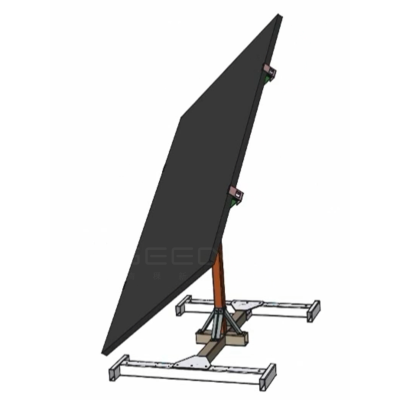
The Solar Tracking Bracket: How to Get 30% More Power from the Same Panel
If your solar panels stay fixed in one position all day, you are leaving energy on the table. A lot of it. Depending on where you live, a solar tracking bracket can boost your annual output by 15% to 30% without adding a single extra panel. For balcony and small rooftop installations, this can mean the difference between breaking even in year four versus year six.
In this guide, we explain the physics, the real-world data, and whether a tracking bracket makes sense for your specific situation.
Why Panel Angle Matters: The Physics of Solar Irradiance
Solar panels produce maximum power when sunlight strikes them at a 90-degree angle. The moment the sun moves, that angle changes, and output drops according to the cosine of the incidence angle. At a 45-degree angle, a panel captures only about 70% of the available energy. At 60 degrees, it drops to 50%.
For a fixed panel, the best you can do is set it at your latitude's optimal annual tilt (roughly 0.9 times your latitude) and accept the seasonal compromise. In Berlin (52°N), a fixed panel tilted at 47° performs well in summer but underperforms significantly in winter, when the sun sits low on the horizon.
A tracking bracket changes this equation by continuously adjusting the panel's angle to follow the sun's path across the sky.
Fixed vs Tracking: How Much More Power Can You Really Get?
The energy gain from tracking is not a marketing claim. It is well-documented science. Here is what peer-reviewed studies and national labs report:
| Tracking Type | Typical Annual Gain | Key Study / Source |
|---|---|---|
| Fixed tilt (optimal angle) | Baseline | NREL PVWatts default |
| Single-axis tracking | +15% to +30% | ScienceDirect Taiwan study: +18.7% |
| Single-axis (high latitude) | +28% to +33% | Springer Turkey Mediterranean study |
| Dual-axis tracking | +30% to +45% | ScienceDirect Tunisia study: up to +44% |
The chart below shows how a single-axis tracker compares to fixed and dual-axis systems for a typical 500W panel installation:
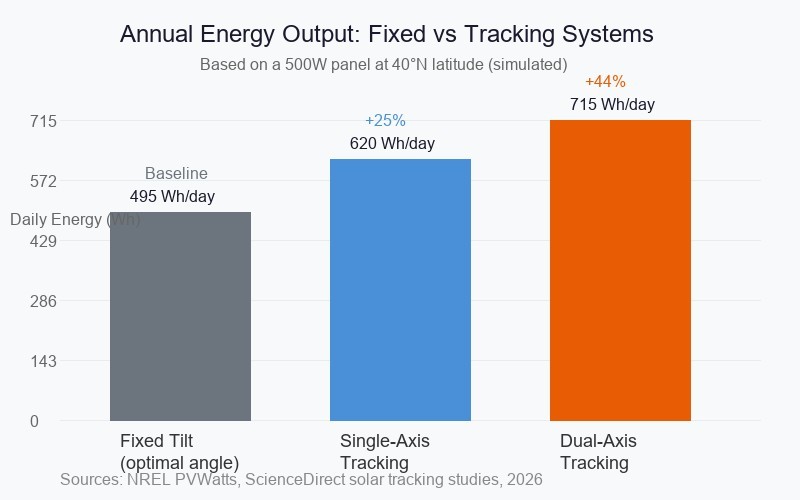
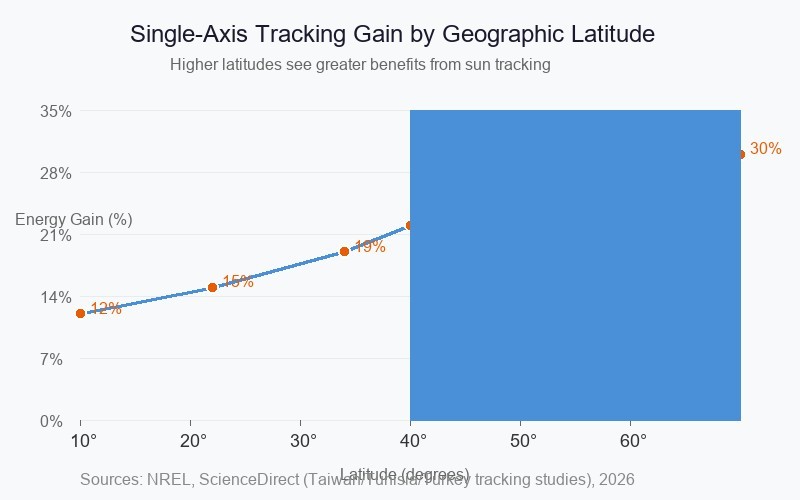
Key insight: The further north you live, the bigger the tracking advantage. At 50°N latitude (Munich, Prague, southern UK), single-axis tracking delivers closer to 30% gains. Near the equator, the benefit shrinks to 10-15% because the sun's path varies less.
Single-Axis Tracking: The Sweet Spot for Balcony Solar
For residential and balcony installations, single-axis tracking is the practical choice. Dual-axis systems add cost, complexity, and wind exposure that rarely justify the extra 5-10% gain for small setups.
A single-axis tracker follows the sun's east-to-west path, typically using:
- Astronomical algorithms that calculate the sun's position based on time and GPS coordinates
- Light sensors for real-time fine-tuning and cloud compensation
- A low-power actuator (DC motor or linear actuator) to adjust the panel tilt
- A wind-protection mode that returns the panel to a horizontal position when gusts exceed safe thresholds (typically 17-24 m/s)
Modern residential trackers are remarkably compact. The EcoFlow Single-Axis Solar Tracker, for example, weighs just 11 kg, supports panels up to 25 kg, offers an adjustable range of 10° to 85°, and carries an IP68 waterproof rating. These specifications show that tracking technology has matured beyond industrial-scale farms into consumer-friendly hardware.
How GEECO's Sun-Chasing Bracket Works
GEECO's tracking bracket is designed specifically for balcony and small-roof installations where space is limited but every watt counts. The system integrates three core technologies:
1. Astronomical + Sensor Fusion Control
Instead of relying solely on light sensors (which can be fooled by reflections or partial shading), GEECO's controller combines a pre-programmed astronomical algorithm with ambient light feedback. This dual-mode approach ensures accurate tracking even on overcast days or when neighboring buildings create complex shadow patterns.
2. Ultra-Low Power Actuation
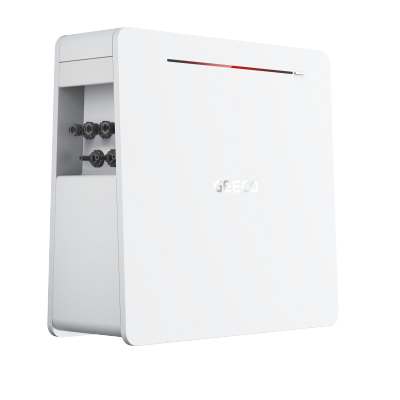
The bracket's DC actuator consumes less than 5 kWh per year, roughly 0.3% of the extra energy it helps capture. A built-in 36Wh backup battery ensures the system returns to a safe position during power outages.
3. Storm-Lock Safety
When wind speeds exceed 18 m/s, the system automatically rotates the panel to a near-horizontal "storm position" within 2 seconds. The bracket is rated for survival winds up to 37 m/s (Category 1 hurricane force) and uses hot-dip galvanized Q235B steel for corrosion resistance.
Installation, Maintenance, and Weather Resilience
Installation of a single-axis tracking bracket adds approximately 30-45 minutes to a standard balcony solar setup. The process involves:
- Mounting the base bracket to the balcony railing or wall (using the same clamps as fixed mounts)
- Attaching the pivot arm and actuator
- Securing the solar panel to the tilt frame
- Connecting the control box to the actuator and power source
- Calibrating the zero position via the app or manual dial
Maintenance is minimal: a monthly visual inspection of bolts and actuator movement, plus seasonal lubrication of the pivot joint. The self-lubricating bearings used in the GEECO bracket are rated for a 25-year service life.
The Economics: Does Tracking Pay for Itself?
Let's run the numbers for a typical German balcony installation:
| Metric | Fixed Mount | With Tracker |
|---|---|---|
| System size | 800W | 800W |
| Annual output (Berlin) | ~750 kWh | ~950 kWh (+27%) |
| Tracker cost (approx.) | — | €150-250 |
| Extra annual savings (@ €0.35/kWh) | — | ~€70 |
| Tracker payback | — | 2.1-3.6 years |
For a system already expected to pay back in 4-6 years, adding a tracker can shorten that timeline by 8-14 months. Over a 20-year lifespan, the cumulative extra generation easily justifies the incremental cost.
Who Should Use Tracking: Geographic and Situational Factors
Tracking is not for everyone. Here is an honest breakdown:
Best candidates for tracking:
- Locations above 40°N latitude (most of Europe, northern China, northern US/Canada)
- Unshaded south-facing balconies or rooftops with clear east-to-west sightlines
- Users who want to maximize generation from a limited number of panels
- Installations where adding more panels is not possible due to space or regulation limits
Situations where tracking adds less value:
- Tropical or near-equatorial locations (sun path is already near-optimal year-round)
- Heavily shaded installations where direct sunlight is intermittent regardless of angle
- Very high-wind regions where the storm-lock mode triggers frequently
- Budget-constrained users who can add one more panel for less than the tracker cost
DIY alternative: If you are technically inclined, a basic single-axis tracker can be built for under €50 using an Arduino, two light-dependent resistors (LDRs), and a 12V linear actuator. Open-source projects on GitHub provide complete schematics and code. However, the lack of wind protection and weatherproofing makes DIY solutions best suited for sheltered installations only.
The Bottom Line
A solar tracking bracket is one of the most cost-effective upgrades you can make to a small solar system. For northern European balcony installations, the 25-30% output gain translates into real money saved and a faster payback period. The technology has matured from industrial-scale farms into compact, consumer-grade hardware that installs in under an hour.
If you are already investing in balcony solar and cannot add more panels, a tracking bracket is the logical next step to squeeze every possible watt from your setup.
Have questions about whether tracking makes sense for your specific balcony? Contact the GEECO support team for a free latitude-based efficiency estimate.