Why Solar Panel Prices Are Dropping and What It Means for Homeowners
Homeowners shopping for solar in 2026 are seeing something they have not seen in a decade: panel prices that barely move. The dramatic collapses of the 2010s are over, but their legacy is enormous. This article explains why solar panels got so cheap, why the panel is no longer the expensive part, and what that means for your buying decision this year.
The Price Curve: From $7.50/W to $3.00/W
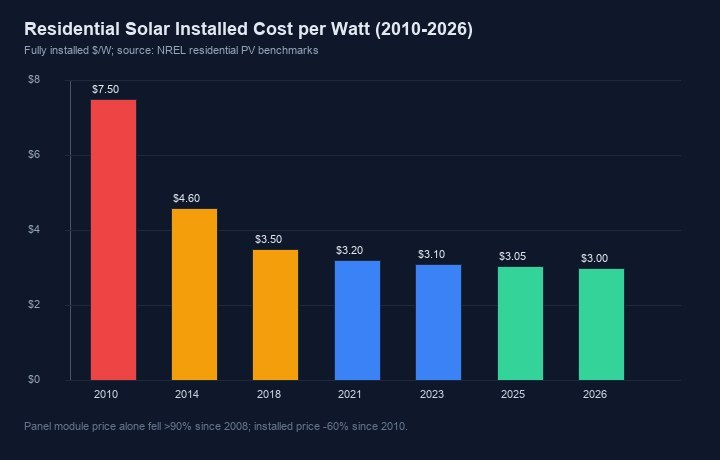
Residential solar installed cost fell from about $7.50 per watt in 2010 to roughly $3.00 per watt in 2026, according to NREL benchmarking data. That is a 60% drop in the fully installed price, and a far steeper drop in the panels themselves. Module prices alone fell from around $4.00 per watt in 2008 to under $0.30 per watt by 2023, a decline of more than 90%.
The steep part of the curve is behind us. NREL projects only 2-4% annual declines through 2030, and BloombergNEF expects module prices to fall just 3-6% per year for the rest of the decade. The era of 15-20% annual cost cuts is over.
Why Panels Got So Cheap
Three forces drove the collapse. First, China's massive scale of photovoltaic manufacturing created economies no Western factory could match individually, with heavy automation and vertical integration pushing cell costs toward commodity levels. Second, silicon purification and wafer-cutting technology improved steadily, cutting material waste and energy per watt.
Third, cell efficiency rose from a commercial average of 14-15% in 2010 to 20-22% today, delivering more power from the same silicon. The pattern is so consistent it has a name: Swanson's Law, which observes that module prices fall about 20% for every doubling of cumulative global shipments. Global capacity grew from roughly 40 GW in 2010 to over 1,600 GW by 2023, and prices followed almost exactly.
The Plot Twist: Inverters, Not Panels, Now Drive Cost
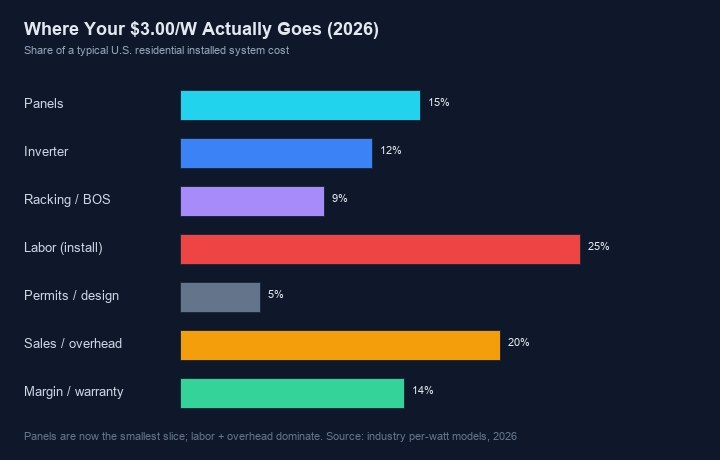
Here is what surprises most buyers. Panel hardware is now only about 25-30% of a residential system's total installed price. The rest is "soft costs": labor, permitting, sales, and overhead, which have proven far stickier than hardware prices.
Look at a 2026 system by component. Panels run $0.30-0.70 per watt. The inverter, the device that converts panel DC into usable home AC, runs $0.25-0.45 per watt, often 8-13% of total cost and the single most failure-prone component over 25 years. Racking and balance-of-system add $0.20-0.35. Labor alone is $0.50-1.00 per watt, 16-29% of the bill.
The implication is uncomfortable for anyone waiting for panels to get cheaper: they already have. The next dollar of savings comes from cutting labor and overhead, not from the module.
How Plug-and-Play Removes the Labor Barrier
This is where the product category matters. Traditional rooftop solar bakes in $0.50-1.00 per watt of installation labor plus permits and design fees. Plug-and-play balcony and portable systems sidestep most of that. A renter or apartment dweller plugs an 800W kit into a wall socket after a simple online registration, with no crew, no permit, and no electrician.
By removing the labor line item, plug-and-play systems convert solar from a construction project into a consumer appliance. The panel price drop that took 15 years to achieve is now passed almost directly to the buyer, because there is far less else to pay for.
The New Math: Total Cost of Ownership in 2026
For a typical homeowner, the relevant number is not the panel price but total cost of ownership. A $3.00 per watt system on a 6 kW roof is about $18,000 before incentives, roughly $12,600 after a typical 30% credit in markets where it still applies. Payback runs 7-10 years nationally and under 7 years in high-rate states like Massachusetts and California.
The chart above shows where that $3.00 actually goes. Panels are the smallest slice. That is good news: it means technology risk is low and savings are predictable, but it also means shopping for the cheapest panel misses the point. Negotiating installer overhead, which varies by $0.25-0.75 per watt, moves the needle far more than waiting for modules to fall another few percent.
Is Now the Best Time to Buy?
The honest answer is nuanced. Waiting one year might save $600-900 on a typical 8 kW system through further price declines, but it also forgoes 12 months of electricity savings, often $1,200-2,400 in high-rate states. In markets where the federal 30% tax credit expired at the end of 2025, that policy change dwarfs any price drop you might capture by waiting.
| Lever You Control | Lever That's Exhausted |
|---|---|
| Your electricity rate and live incentives | Global panel spot price (-90% already done) |
| Installer overhead negotiation ($0.25-0.75/W) | Waiting for module drops (2-4%/yr) |
| System sizing and self-consumption | Panel efficiency race (already 20-22%) |
For most homeowners, the variables that matter are local: your electricity rate, available incentives, and roof orientation, not the global panel spot price. If your rate is high and incentives are still live, acting now beats waiting for a discount that may not come.
Honest caveat: these are U.S.-centric benchmarks. European balcony solar, Asian markets, and off-grid cases have different soft-cost structures, and local incentives change the math entirely. Always compare all-in price per watt from at least three quotes.
GEECO's Pricing Philosophy: Solar as an Appliance
GEECO's approach starts from the new reality: panels are cheap, so the value is in everything around them. Built-in anti-backflow removes the cost and failure points of an external export-limitation box. Self-developed micro-inverter and EMS engineering reduces the single most failure-prone component to a reliable, warranty-backed unit. Plug-and-play packaging eliminates installation labor entirely for balcony and portable use cases.
The goal is simple. Solar should behave like a dishwasher or heat pump: unbox it, set it up in an afternoon, and let an app confirm it works. When the panel is already 15% of the cost, the brand that wins is the one that strips out the other 85% of friction, not the one that shaves another cent off the module.